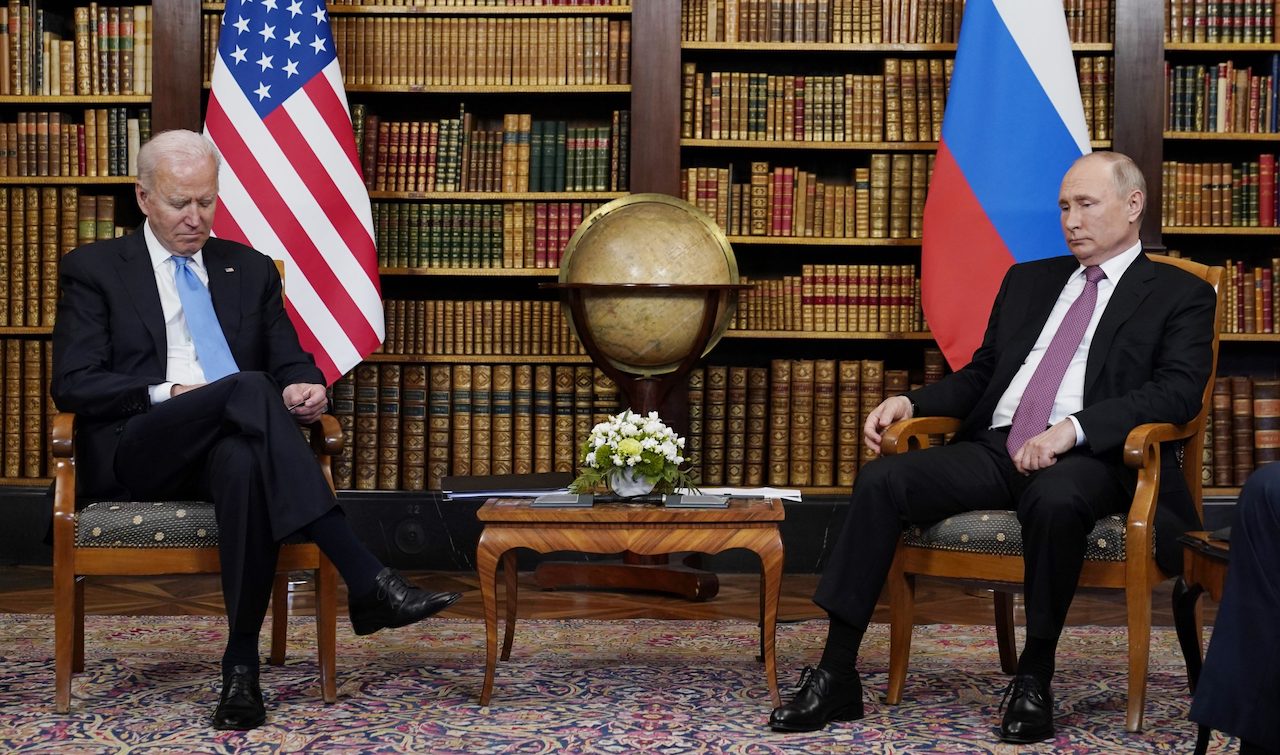
Major tensions continue to escalate in the power struggle between the U.S. and Russia over control of Ukraine.
Recently, the Biden administration claims to have intercepted plans for what they say is a buildup of Russian troops and military equipment at the Ukrainian border as part of preparation to invade Ukraine with as many as 175,000 troops. They also claim Russia is simultaneously organizing from within Ukraine to carry out a coup to oust Ukrainian President Volodymyr Zelensky.
In response, the U.S. has threatened to impose a new round of harsh economic sanctions against Russia, as well as to increase military support for Ukraine in the event of a Russian invasion. Last week, after U.S. Secretary of State Antony Blinken met with top commanders of the North Atlantic Treaty Organization (NATO) over the alleged Russian military escalation, he said, “We made it clear to the Kremlin that we will respond resolutely, including with a range of high-impact economic measures that we’ve refrained from using in the past.”
Meanwhile, Russian President Vladimir Putin has denied all claims of plans to invade Ukraine and has in return charged that the U.S. is simply using these false accusations as an excuse to increase the military forces in Ukraine. In addition, Russia responded to claims by Ukrainian President Zelensky that Ukraine plans to retake Crimea from Russian control. Last week in a speech to Ukrainian Parliament, Zelensky said that Crimea was part of Ukrainian territory and that they were going to “liberate” it from Russia. In response, Russian Minister of Foreign Affairs Sergei Lavrov said that the conflict over Ukraine is returning to the “nightmare scenario of military confrontation.”
The U.S. and Russia have been engaged in a power struggle over Ukraine for several years. Tensions escalated in 2014 when the U.S. supported a coup to oust the elected Russian-backed president Viktor Yanukovych. In response, Russia invaded and soon annexed Crimea, the south-eastern peninsula of Ukraine.
Since then, the U.S. has been aggressively trying to accelerate Ukraine’s entrance into NATO with plans to expand NATO military bases into the region as a direct threat to Russia. NATO, with participation from the Ukrainian military, has been provoking Russia with several military exercises in the region, including naval exercises in the Black Sea, ongoing military training near Russia’s Ukrainian border, flying U.S. bombers and NATO fighter jets over Russian airspace and more.
These provocations culminated last week when NATO Secretary-General Jens Stoltenberg made another comment about building up nuclear weapon sites in the states “east of Germany,” which of course is a direct threat to Russia.
At the same time, control over Ukraine is important for Russia to continue to export its vast natural gas supply piped through Ukraine into Europe. Russia supplies more than 30 percent of the natural gas to Europe. Control over the pipelines through Ukraine is an essential part of controlling this natural gas supply.
As an alternative to piping gas through Ukraine, Russia had been working to build an additional pipeline (Nord Stream 2) that runs under the Baltic Sea from Russian oil fields to Germany. Back in March 2021, when the pipeline was still being constructed, the Biden administration threatened harsh sanctions for any country receiving oil from Nord Stream 2. U.S. Secretary of State Antony Blinken warned “that any entity involved in the Nord Stream 2 pipeline risks U.S. sanctions and should immediately abandon work on the pipeline.” Recently, however, since the pipeline has been completed, the Biden administration has tried take back those sanctions as part of a broader trade deal with Germany.
What’s really going on? Is Russia trying to create a pretext to launch an invasion into Ukraine and oust Zelensky? Or is the U.S. trying to create a pretext to intensify the militarization of Ukraine as a threat to Russia? Both seem to be true.
Ultimately, the struggle between Russia and the U.S. to dominate this region of the world and control access to natural gas and other resources continues to escalate. These ongoing provocations only put the entire region and even the whole world at risk. This reckless conflict is just another example of the complete bankruptcy of the global capitalist system, where major powers will risk all-out war and countless lives to enhance their economic dominance.