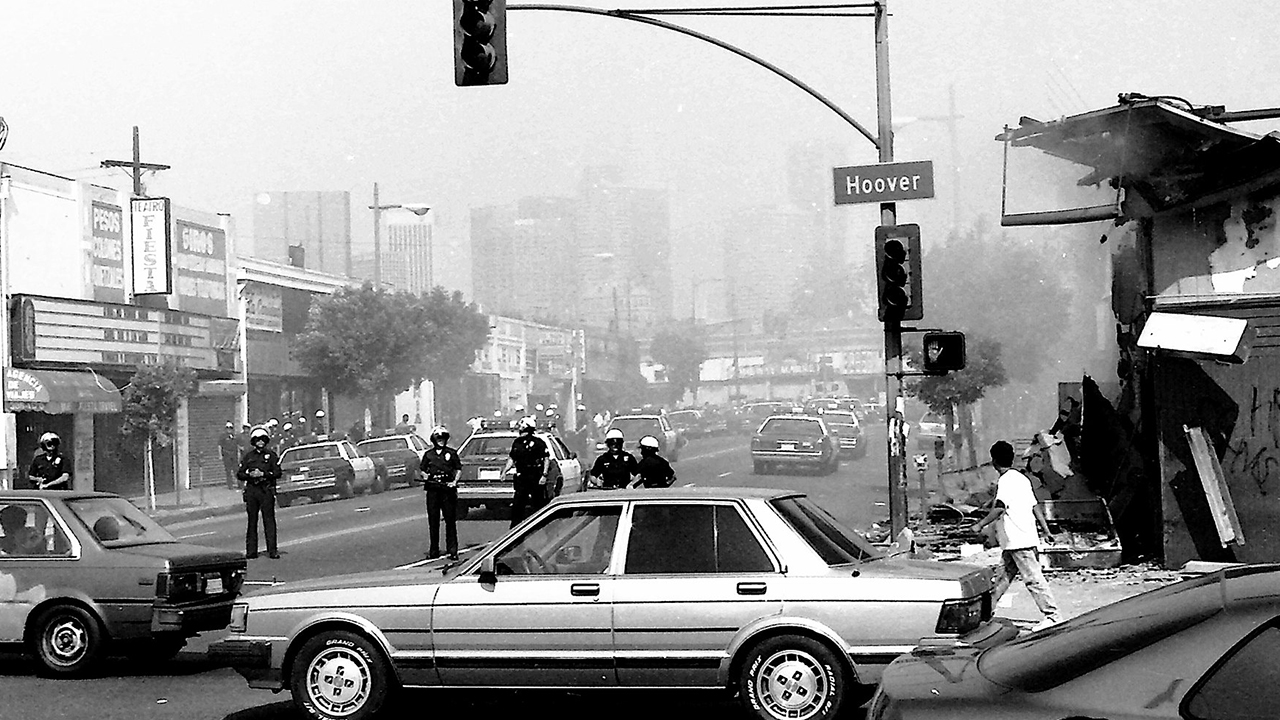
Thirty years ago, from April 29 to May 4, 1992, tens of thousands of poor, working class people in Los Angeles took to the streets in fury after a jury acquitted four police officers for brutally beating Rodney King after a traffic stop.
In the following six days, thousands of businesses and buildings were damaged or destroyed, thousands of state and federal troops occupied large sections of the city, 63 people were killed, thousands were injured, and nearly 12,000 were arrested. Unsurprisingly, the majority of those killed were Black and Latino, while no law enforcement personnel lost their lives.
The Los Angeles uprising was one of many urban upsurges by working people, mostly Black, in U.S. history. From Harlem in 1935, to Watts in 1965, to Newark and Detroit in 1967, to Los Angeles (again) in 1992, to Baltimore in 2015; after every one of these events, there are calls for change. And often a few superficial changes occur: a police chief resigns, one or two cops are found guilty and sentenced, or at least fired, while maybe small investments are made in the community in question.
But despite superficial changes, most of the same problems that sparked the 1992 uprisings, and others, remain. Cops have continued to kill around 1,100 people each year since 2013. And while many of those killed by police are Latino, white, Native American, and Pacific Islander, in L.A., Black people are still nearly three times more likely than whites to be shot or killed by a cop. And poverty in Los Angeles still hovers at nearly 20%, with large homeless populations and concentrated poverty in Black and Latino neighborhoods. This combination of high levels of poverty and suffering, along with consistent police brutality, is the spark that set off nearly every urban uprising of the twentieth century.
The same things that caused the 1992 rebellion are still a cause for rage. With so little change, we can expect that uprisings like the one in 1992 Los Angeles will continue to take place. With hundreds of impoverished Black neighborhoods in the United States, millions of poor and angry people struggling to get by through means both legal and illegal, and police forces devoted to violently containing them, the only question is: where and when?