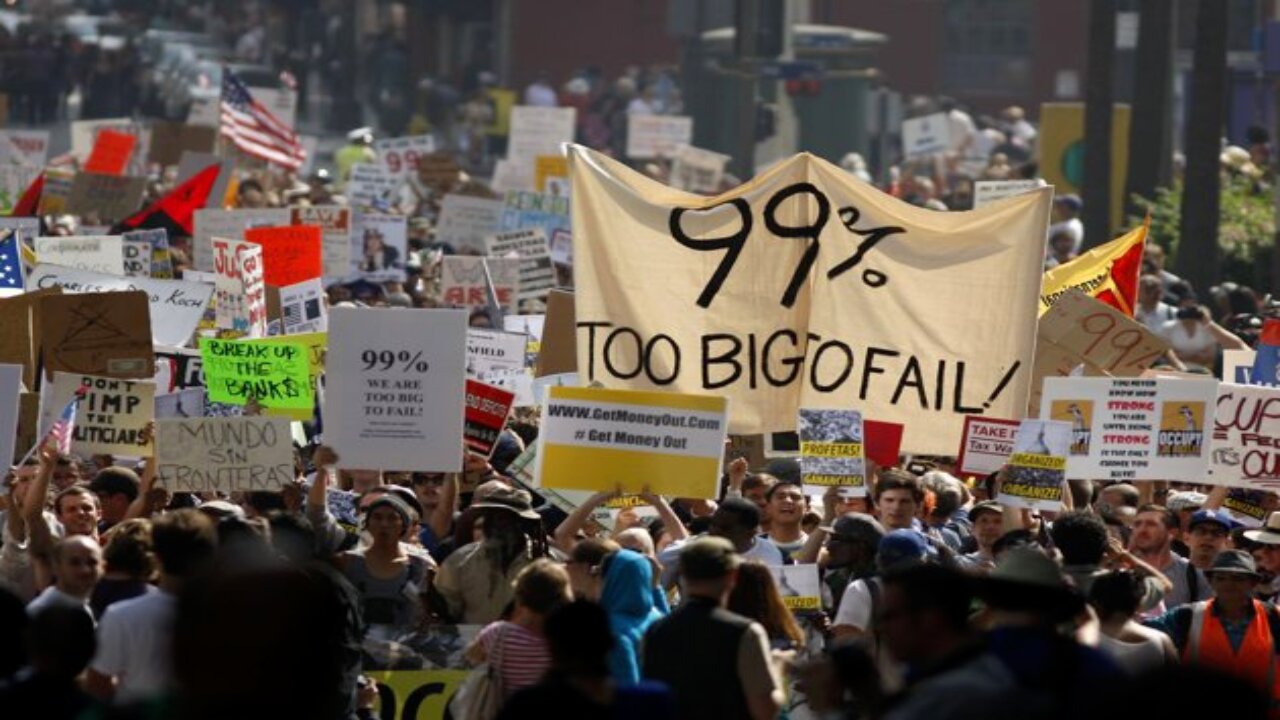
Ten years ago, on September 17, a movement calling itself Occupy emerged on the streets of New York City in Zuccotti Park of the financial district. Quickly the movement spread to other parts of the United States, and eventually, the world. It was an important moment in many peoples’ lives. After all, this many protests in this many cities, all at once, had not been seen in a long time.
These demonstrations were a response to years of “belt tightening” that had been imposed on poor and working people since the 2008 financial crash. People had been hit hard in this crisis, but the rich, in their attempts to recover, worked to push the burden off themselves. Slashing of public budgets, layoffs, and wage and benefit cuts were all ways to put the biggest impact of this crisis on the most vulnerable – poor and working people. These measures made it harder to afford to live, and much harder to climb into any kind of higher position in society. This resulted in a reality where young people seemed to have no opportunities left.
Out of these protests a slogan emerged, one that clearly articulated what the problem was: “the 1% versus the 99%.” It was becoming clearer that there was a tiny minority destroying the lives of the many, and the many were left with no choice but to raise their voices about it.
The spirited protests occupied public spaces for days and weeks at a time. People gathered in parks, or town squares, talking about ideas, and providing food and other resources to one another. Some encampments had libraries, regular meal stations, held classes, and more. And people often tried to make decisions in the encampments democratically. In the process, many felt, for the first time, a taste of what collective life could be like.
Ten years later, it’s important that we remember these demonstrations, and what they stirred up in millions. Often our memory is too short term, and we forget what happened days, weeks, or years before. And though Occupy was the first post-2008 wave of protests, after it died down the same problems remained, and the experiences of the protesters remained inside them, along with the feeling that something needed to be done.
After Occupy we had Black Lives Matter of 2014, post-Trump protest waves, teachers strikes, and the resurgence of Black Lives Matter with the George Floyd protests just last summer. And there are certainly more to come.
We also cannot forget that Occupy was part of a truly global uprising, inspired directly by the Arab Spring, which started in 2010 with one man burning himself alive out of desperation. Like others, he had been trying tirelessly to eke out an existence in Tunisia, where the economic crisis had hit even harder than in the U.S., leading to food shortages and widespread poverty. His actions were a sign that he had endured one too many affronts, and had no other choice but to do something about it. His powerful protest lit a spark not only in Tunisia, Egypt, the Middle East, but much of the rest of the world.
Capitalism is a global system, with global impacts. Internationally we suffer from the decisions of the 1%, but it is also on an international basis that we must all fight back. Occupy was one glimpse into what it means to say no to the system. What we need to organize for is a movement that says no again, but that this time brings down the system for good.