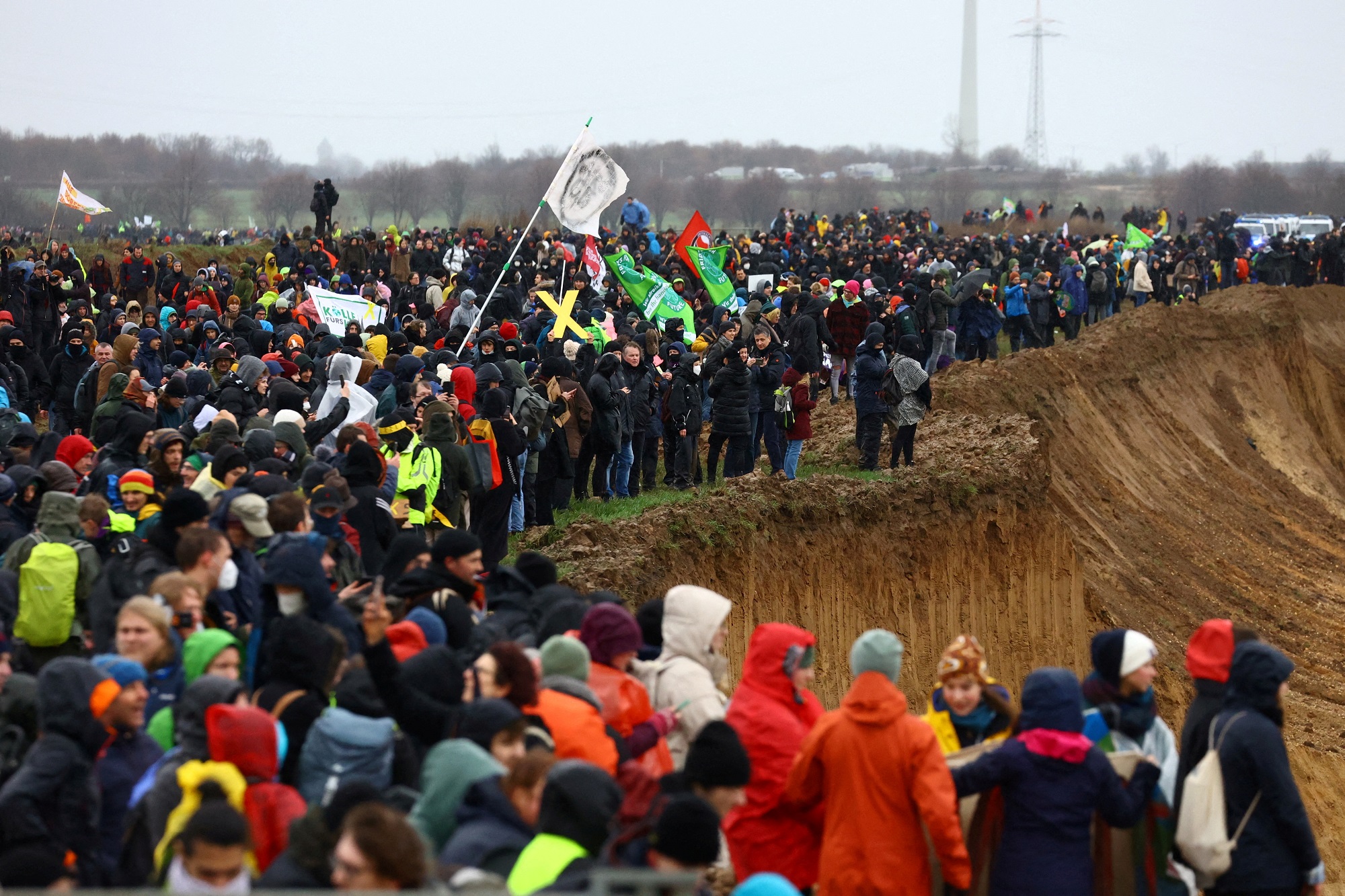
Over 1,000 German police officers in riot gear used water cannons, batons, and brute force to remove at least 15,000 protestors from a coal mine in mid-January. This came after more than two-and-a-half years of activists working to prevent the destruction of another centuries-old village from being demolished for a coal mine. Protesters were removed and arrested from the squatted-in homes, tree houses, bamboo tripod structures, and even from an underground tunnel.
The village of Lützerath was bought by RWE, the largest energy company in Germany, to expand their open-pit coal mine, Garzweiler, one of RWE’s three mines in the region. Lützerath is in a long line of historical villages that have been deemed suitable by the company and the government to destroy. In fact, in 2013 the German supreme court ruled that extension of the coal mine was “overwhelmingly in the public interest,” though not apparently in the interest of the families losing their homes.
For those protesting at Lützerath, there is also great concern that expanding the mine will worsen the climate crisis. The type of coal that would be taken from this mine, lignite, is one of the dirtiest forms of energy. And coal is already responsible for 20% of Germany’s carbon emissions. But Lützerath is a part of a greater trend in Germany.
With the war in Ukraine, the German government has found a new excuse to expand fossil fuel production, undermining stronger emission goals. Since the start of the war, German Chancellor Scholz’s government has restarted at least 20 shut-down coal power plants and postponed the closure of several others, while also investing in brand-new natural gas infrastructure. And although the government claims that they need to burn more fossil fuels, like in the case of RWE’s coal mine, this is not the case. A recent study by the German Institute for Economic Research shows other existing coalfields could be used instead. But this would cut into RWE’s profits.
The German government claims this is a short-term policy. But building up fossil fuel infrastructure isn’t a real solution; this will worsen the climate crisis. This should be a time to drastically cut reliance on fossil fuels, not deepen our dependence on them.
Climate activist, Greta Thunberg, was arrested at the Lützerath protests and said, “[the expansion of the mine is] a betrayal of present and future generations…. Germany is one of the biggest polluters in the world and needs to be held accountable.”