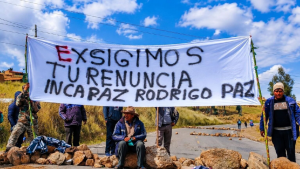
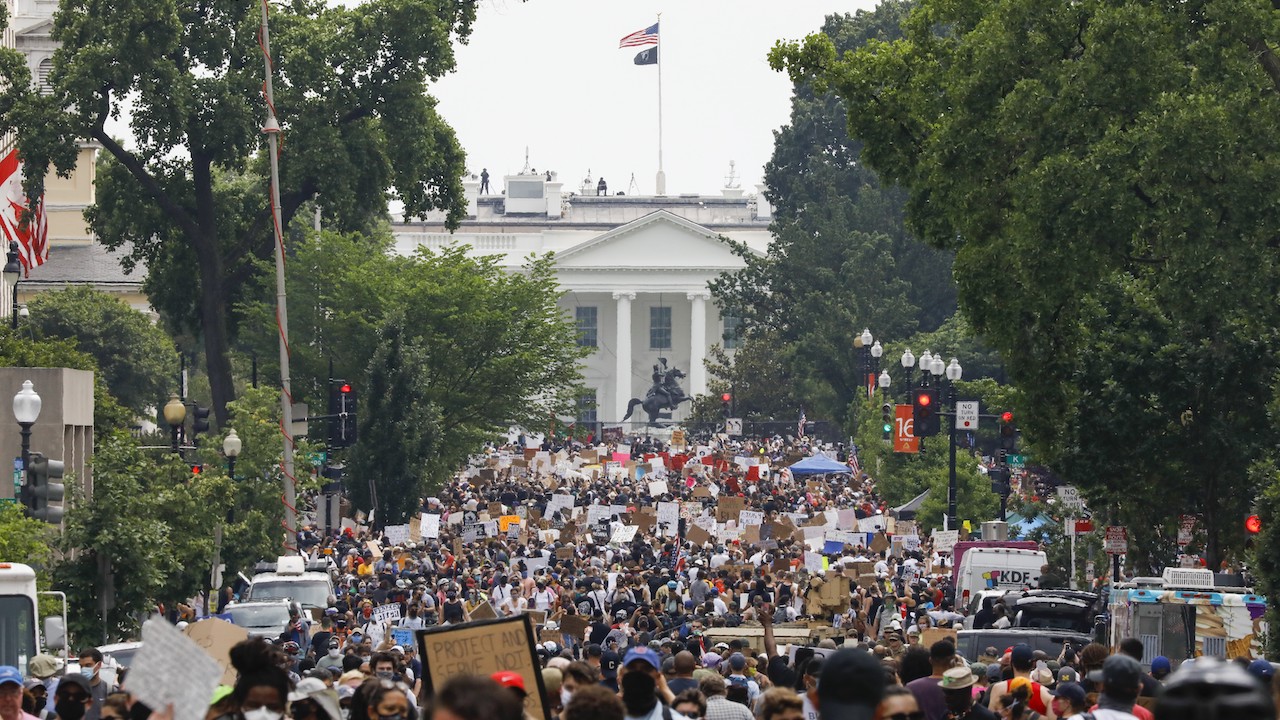
Today, May 25, is the anniversary of the murder of George Floyd. It’s a name we will never forget. His brutal murder by the police set off a mobilization bigger than any we have seen since the Civil Rights Movement. All over the world people were inspired by the wave of protest and anger that swept across the U.S. in big cities and small towns. These protests gave extra fuel to fights happening abroad and inspired millions from Santiago, Chile, Lagos, Nigeria and Gaza in Palestine, to London and Paris and South Africa and beyond. The name George Floyd still echoes in every fight against racism and brutality around the world today.
The high school senior who had the courage to film Floyd’s final confrontation with the police, and put it on social media, could never have known that her actions would unleash a furious mobilization, and its cry would ricochet around the globe.
It was a protest movement that emerged suddenly, igniting a fuel that had been accumulating for years, and continues to accumulate daily. Whether it’s the disproportionate number of people of color murdered by police. Or it’s the many Black communities that have been emptied of resources that once provided some hope and stability but now remain impoverished, and give birth to hopelessness and the violence of the streets. Or it’s the ongoing criminalization of poverty, where Black people are five times more likely to go to prison than whites. The fuel is there for this fire — it is always there, and it can explode at any time.
And now what? Of course, the protests of last year did not end racism or the brutal system of oppression that gave birth to it. But this movement normalized activism for a new wave of people who had never been to a demonstration before. And through this mobilization, a new generation is waking up, one that is becoming increasingly aware of the deep injustice in our world. They are asking important questions about what it will take to uproot racism and fundamentally change this society, and they are organizing to take the next steps. That questioning will take many people down the path of wondering why police continue to exist at all. More and more young people are beginning to see the racism and violence of this society as systemic, and many have begun to question that very system of capitalism itself, and the inequality and violence required to maintain it.
In Minneapolis this weekend, a rally of hundreds gathered to remember George Floyd, and the speakers included the Reverend Al Sharpton, who again encouraged people to narrow their horizons, and pin their hopes on Congress to pass legislation on policing. The changes he’s proposing include a ban on chokeholds and a national database of police misconduct — these proposals are not new.
Chokeholds were banned in New York City in 1993, but that didn’t stop Daniel Pantaleo from choking Eric Garner to death over two decades later. Even after the coroner ruled his death to be a homicide, he was not indicted by a grand jury. When he was fired five years after the fact, it was only because of years of protest. Let’s hope that the young fighters who were brought into this struggle in 2020 can see the limits of these proposals.
A national database of police misconduct is just fine, but it won’t do anything to actually stop the so-called “misconduct” — to achieve that will mean changing the whole society. Of course we must gather to protest and fight every instance of racist violence, but also, we must point to the underlying reasons for this brutality. The brutal violence of this system, the preservation of profit at all cost, the relentless racism that is used to further oppress and divide people – these are all pillars of the capitalist system.
Ultimately, the fight to end the racism and violence of this society is a fight to completely transform the society and the world we live in. To do that, we will need to build up our forces, and organize where our power truly lies, the power of working people, whose labor runs the whole world. Only the collective power of working people has the means to create a society where inequality doesn’t have to be enforced at gun point because rich and poor would finally be a thing of the past.
One year later, we remember George Floyd and the sadness and anger that his death provoked. And we must continue to turn our outrage into fuel for organizing for a better world, a world where George Floyd would still be alive. This is how we can honor him.