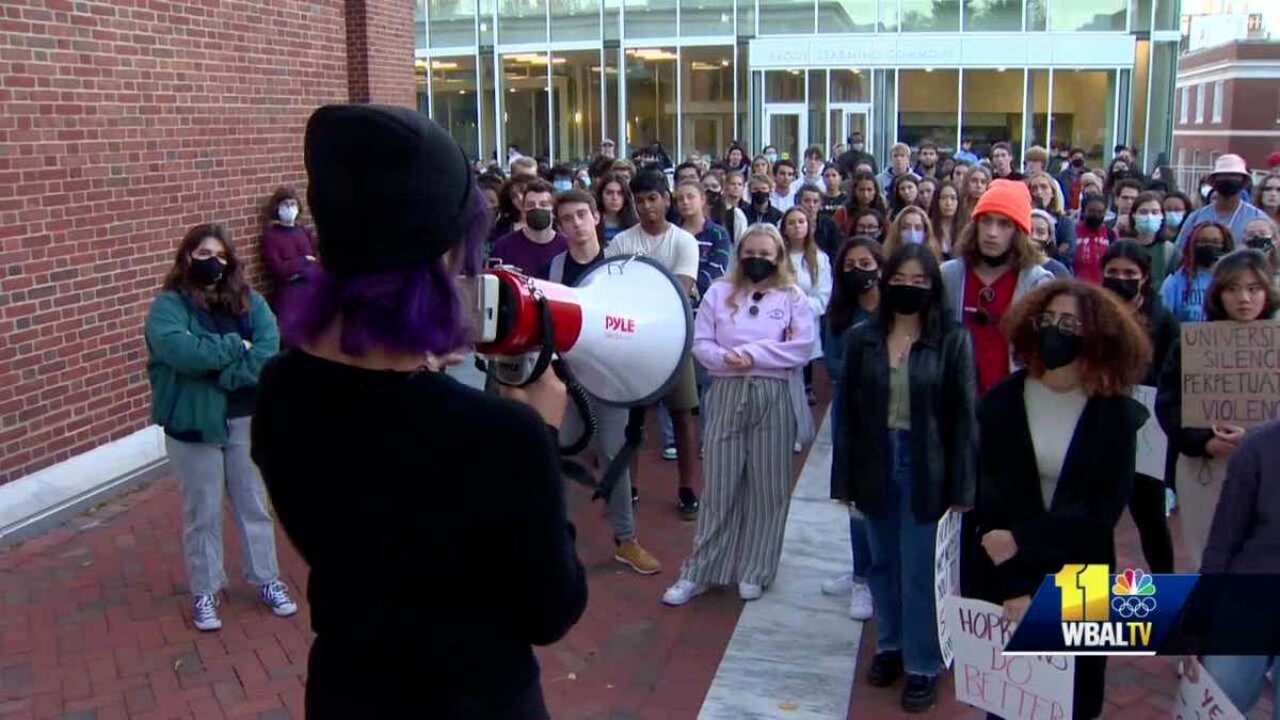
This past Monday, approximately 150 students took part in a protest at Johns Hopkins University in response to the University’s failure to properly prevent and respond to sexual assaults on campus. The protest was sparked by an alleged intentional drugging at the Sigma Phi Epsilon fraternity house on Halloween weekend and the University’s victim-blaming response to the situation in a student-wide email that gave tips on how to avoid being drugged, rather than addressing the perpetrators of the drugging.
The organizers called for the University to overhaul the Office of Institutional Equity, which is responsible for handling sexual assault cases, overhauling the Counseling Center to provide proper support for victims, and creating concrete punishments for perpetrators of sexual assault.
At the start of the protest the organizers had the crowd take part in an exercise. Everyone who knew someone that was sexually assaulted on campus was asked to raise their hand. Looking around, every hand in sight was up.
Afterwards students donned signs, chanted and marched through the University, ending the protest in a candlelight vigil for victims of sexual violence and an open discourse. At the discourse students opened up about their experiences dealing with sexual assault and the University.
Students talked about how many people in their lives did not believe they were sexually assaulted and how dehumanizing sexual assault is. Some expressed that a consequence of the assault was feeling disgusted with themselves and their bodies. Students brought up not reporting sexual assault because of the victim-blaming attitude of the University, and the difficulty of dealing with the red tape of University bureaucracy. Listening to these students’ stories is infuriating and begs the question, why are these experiences normal?
The University bureaucracy’s poor handling of these assaults is not accidental. The administration has designed a bureaucracy that is inefficient and confusing to navigate in order to silence victims. The silence of victims allows the University to cast itself as a campus safe for all students; but this is nothing but optics. Even then, reforming the administration is not enough. The roots of sexual violence run deeper. Sexual violence is a reflection of our society, where it is acceptable and encouraged to dominate others in order to raise oneself up. Sexual violence is routinely normalized within a system that exploits the majority for profit. What then will it take to address sexual violence?
For now we must stand together, and push back against their bureaucracy, and force them to meet our demands. Joining together in this fight, we can promote a culture of human dignity and respect for women. But we do this knowing that we need to address this violence by addressing the oppressive system head on as well, and organize to build a world where raising oneself up on the backs of others is simply not allowed.