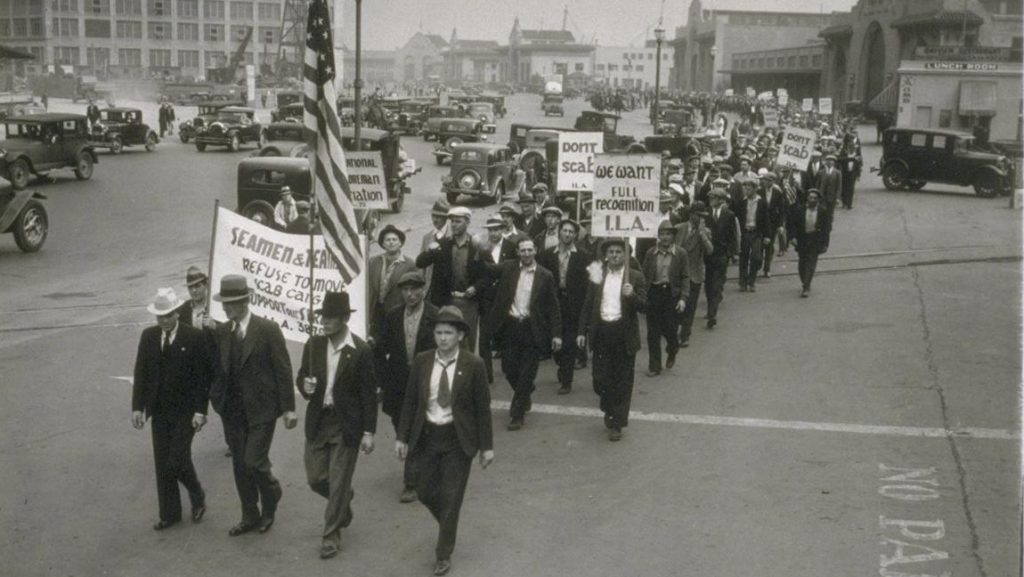

The Flint Sit-Down Strike at General Motors in 1936-37 was the biggest strike in the U.S. during the Great Depression. It not only set an example for the entire American working class but also showed that women could play a decisive role.
General Motors was the heart of U.S. industry and was the biggest company in the world. Of the several plants in Flint, Michigan, the largest plant had tens of thousands of workers. GM had been preparing for war against the workers if they ever decided to stand up for themselves. GM had more tear gas and riot control equipment than all of the police departments in the U.S. combined. They hired lip readers to spy on workers, and paid armed thugs to intimidate, beat and even kill organizing workers.
During the Great Depression, the lives of working people everywhere were very rough and it was no different in the GM plant in Flint, Michigan. GM made people do backbreaking work at a faster and faster pace, without any recourse to protect themselves. In Flint, a city of 150,000 people, 80 percent of the workforce was employed by GM, who essentially ran the city, controlling everyone from the judges, police department, mayors and churches.
Workers began to organize a union to defend themselves. Prior to the strike, there had been revolutionary groups who had been organizing in the plant because they saw it as a battle of the working class in the fight for a new society. They spent a lot of time and effort building relationships and networks, discussing with the workers, and holding classes on the history of the working class, on socialism and other topics.
When the first plant in Flint went on strike, the workers sat down and occupied the building to not only shut down production but also to prevent anyone to break the strike. The workers began to organize everything from daily meetings to concerts to political classes to sports inside the plant.
Most women in Flint were very isolated, tied to raising children and taking care of the home. The company did everything it could to make the women suspicious their husbands were cheating on them rather than going to union meetings. In the beginning, women became a drag on the strike. Many of the wives felt that it was a terrible idea to strike because they thought it would never accomplish anything and that the men were lucky to even have a job, so they came out to the sit-in, urging the men to end their strike.
One of the revolutionary organizers and wives of the strikers, Genora Johnson, saw this and understood that the women should be organized in support of the strike. She and other women organized childcare so they could join the picket lines and cook food for the strikers. More and more women kept bringing even more women.
During a heated battle with police, women were able to break through the police lines and save the strike. At this point Genora decided it was necessary to put out a call for a Women’s Emergency Brigade, so any willing women could act as a defense guard, rallying support for the strike, building links with other plants on strike, and be ready for battle at all times. The Brigade grew from 50 women to 400 who did everything from smashing the windows of the factory when the police shot tear gas inside to standing shoulder to shoulder to prevent the cops from entering.
After mobilizing the support of the working class community in Flint, finally the company had to give in and bargain with the worker’s new union, the United Automobile Workers. The next year, the UAW membership grew from 30,000 to 500,000. This victory was the turning point within the workers movement and sent shockwaves across the country. In 1936 and 37, there were more than 1,000 sit-down strikes all over the country, all of them victorious.
Everyone who participated during the strike was transformed and had a new sense of dignity. The experience of organizing and living together gave them all a taste of what a different society could be like. The determination of the Women’s Emergency Brigade and their insistence to get out of the kitchens and join the strike helped lead to the victory of the strike. The crucial role that women played during the strike showed everyone including the women themselves how much they were capable of.