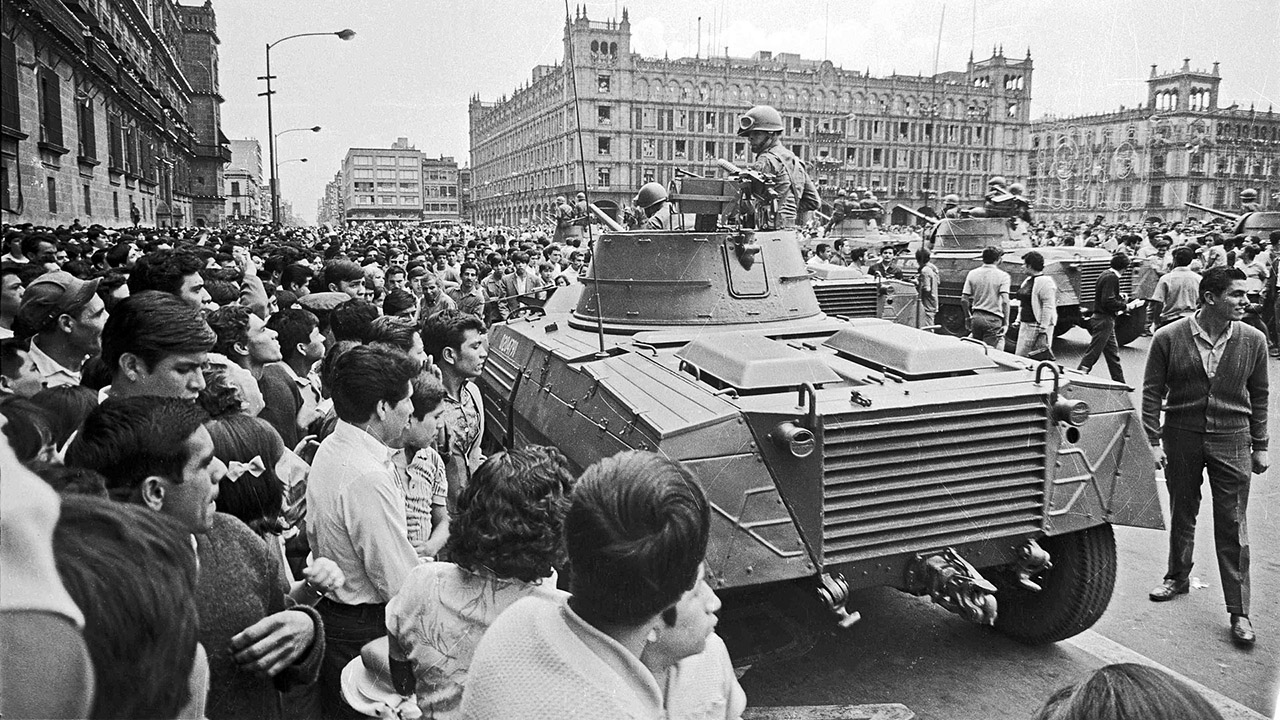
On October 2, 1968, a peaceful demonstration of nearly 15,000 people took place in Mexico City. As speeches wrapped up and people prepared to march, soldiers, armed with heavy artillery and tanks, moved in to trap and arrest the protesters. At that moment, snipers began firing into the crowd, sparking a shootout between them and the military units who were unaware of what was happening. Many demonstrators and civilians were caught in the crossfire. After the shooting ended, more than 300 people lay dead and over 1,300 were reportedly arrested.
The Tlatelolco massacre was a planned attack by the Mexican government. For months, hundreds of thousands of people had hit the streets to demand an end to the country’s growing inequality, government corruption, and the lack of democracy. For nearly four decades, Mexico’s Institutional Revolutionary Party (PRI) had ruled the country with an iron fist, suppressing all forms of freedom of speech, organization, and political activity not under its control. The government’s economic policies over the years had also pushed the majority of the population into poverty, all while enriching Mexico’s elite class. People wanted change.
The protests began in early summer as Mexico was preparing to host the Olympic games. The authorities were intent on giving the world the impression that Mexico was a progressive and prosperous nation. Millions of dollars were spent on staging the event. This outraged many people who believed those resources could instead have been invested into meeting the needs of the population. Inspired by movements occurring all over the world that year, many began to speak out for the first time. Led mostly by young students, protests were organized on university campuses and cities throughout the country.
However, rather than addressing the protesters’ concerns, the government responded with intense repression. Riot police and the military were sent in to occupy campuses and crush the demonstrations. The government saw the growing movement as a serious threat to its authority and did not hesitate to use violent force in stopping it.
The attack at Tlatelolco was unfortunately enough to finally end the movement. Afterwards, the authorities and media covered up the incident and denied any government involvement. But for those that participated, the experience had succeeded in breaking their fear and silence. This generation was changed forever. They gave rise to a new wave of activists who were determined to continue fighting for social and political change for decades to come.
The state violence that was inflicted on Mexico’s youth that year continues to this day. On September 26, 2014, 43 student activists who were on their way to Mexico City for the anniversary of the Tlatelolco massacre were abducted by police and military forces. They were handed over to local drug cartels and never seen again. Later, charred remains of some of their bodies were found dumped on a river bank. And just like in Tlatelolco, nobody has been held accountable for the killings.
It’s struggles like these that remind us of what we are really up against—a system that will stop at nothing to defend the interests of the ruling classes. It will take a global mass movement, led by ordinary people, to finally bring this system down to its knees. The students in Tlatelolco rose up against exploitation and oppression, and it’s up to all of us to continue that struggle by fighting for our own liberation today.