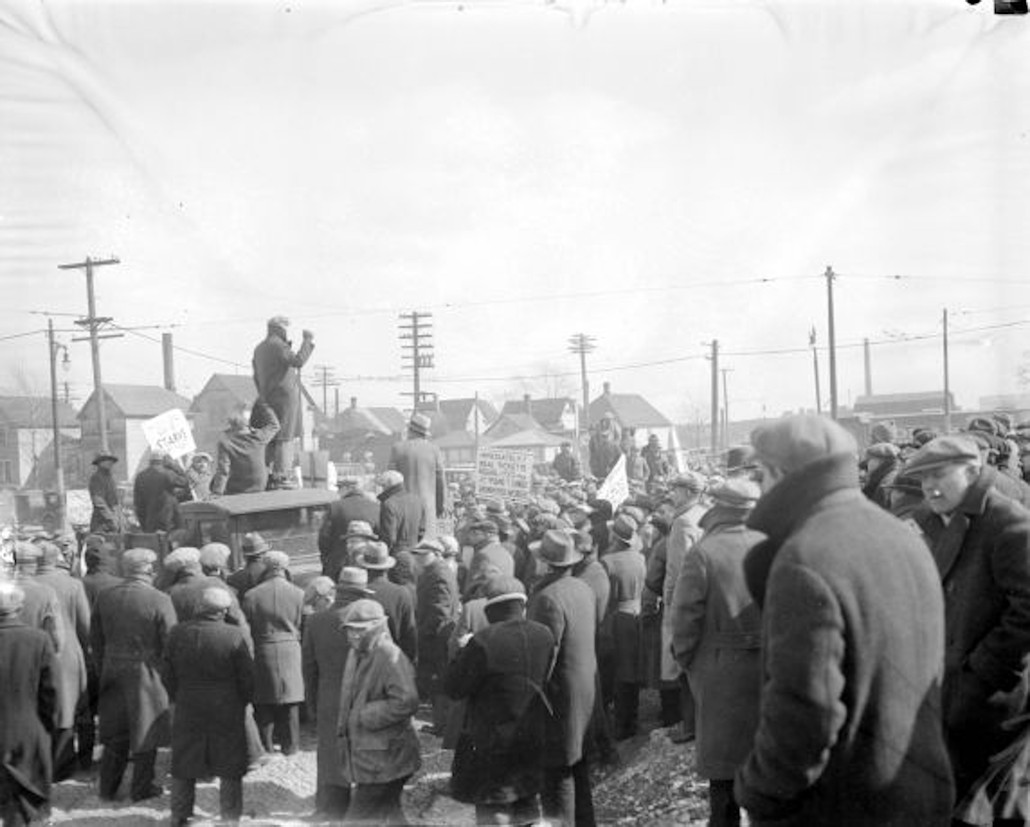
On March 7, 1932, an explosive confrontation took place when at least 3,000 Ford workers and unemployed members of the Detroit area working class began a march on Henry Ford’s massive River Rouge plant in next-door Dearborn, Michigan. As the march unfolded, the violence of the capitalist system was unmasked as police and hired thugs fired upon and killed marchers. Today, March 7, we remember these tragic events.
During the harshest years of the Great Depression that began in fall of 1929, the Ford Motor Company laid off nearly half of its workforce, around 60,000 workers. For those that were still employed, average wages had fallen by one-half of what they were previously. Workers who remained were kept in line by the “Ford Service Department,” a team of hundreds of paid informants and thugs who spied on, intimidated, and sometimes outright beat up workers who complained or worked to organize their fellow workers. For more than two years, conditions worsened for large segments of the local population. Homelessness increased as banks desperate to stay afloat carried out foreclosures and evictions. Desperation increased as the harsh Michigan winter of 1932 dragged on and malnutrition and starvation threatened the impoverished population. The rate of suicides in Detroit shot up over 5 times as high as what they were before the Great Depression.
Despite suffering and repression, workers in the factories, councils of unemployed workers, and members of the Communist Party and other socialists organized both inside and outside the factories to protest worsening conditions. The group was multiracial, bringing together workers of every ethnic group, not on the basis of their race or ethnicity, but on the basis of their shared membership in the working class. It was clear that they had one shared set of interests, whereas Henry Ford and other corporate owners and leaders had another.
They agreed on conducting a mass protest march to the River Rouge factory, and to a list of demands to put to Ford at the end of a march. The list included, among others, demands for jobs for all laid-off Ford workers, a seven-hour workday with no reduction in pay, an end to discrimination against Black workers, five tons of coal and coke for winter heating and cooking, abolition of company spies and thugs, and an end to foreclosures on the homes of Ford workers. This combination of workplace demands and larger social demands were things the workers and unemployed desperately needed, but were concessions that neither Ford nor any other capitalist would ever make.
On March 7, the march began in the biting cold of Detroit. Workers carried signs that read, “Give Us Work” and “We Want Bread Not Crumbs.” The marchers had no trouble in Detroit, but when they got to the border with Dearborn, the neighboring town where the River Rouge factory is located, they were met by police. As they crossed the border they were met with teargas and sprayed with cold water from an overpass. Workers scattered and began throwing stones at the police, injuring some. Police fired more teargas, and workers continued throwing stones in response. In this chaotic, smoky situation, a gun was fired, most likely by one of the heads of Ford’s “Servicemen.” Police also opened fire, using machine guns as well as revolvers. In the violent melee, at least 50 were wounded with four shot dead, and one mortally wounded who died months later. The local politicians and press, all owned or heavily influenced by Ford and the other big auto companies in the area, falsely portrayed marching workers and “communists” as planning and initiating the violence. The reality was the opposite: workers and the unemployed faced violence when they were fired upon and killed for demanding basic human necessities in response to the violence of poverty.
The Detroit Hunger March became another example of what happens when the capitalist system goes into crisis and threatens people’s very ability to survive. When a crisis hits, working people demand that the system meet their needs, and in response the capitalists use force to protect their wealth, their factories, their profits, and their system. The violence of that day is yet another example of the violence of the system.
While the march and the conflict that occurred were tragic losses, they were also parts of a longer, larger struggle. They were part of the long workers’ struggle to organize and fight back and eventually win real gains from the bosses who profit from exploiting our labor. The violence of the day made clear to some just how unacceptable the system was, and that they needed to do something to change it. David Moore, a Black worker at the River Rouge plant, described the effect the March 7 march had on him:
That day, my life changed completely. I was a new person. I was a young man, like most of the rest of them was, who didn’t give a damn about too much of a thing, but my family was suffering like theirs and I tried to do something to help ‘em. But from that day on my life changed. It changed politically, it changed religiously, it changed economically… It wakened me up financially, on what was really happening in this country. The few had every damn thing, and the many didn’t have anything. The many, who made it possible for the few to have all of the wealth of this country, and control it, the wealth of the country. There was no union, they had no insurance. The owners… were making money off of people who were gonna die. And that’s what changed me.
He and others were driven to become part of the workers movement that organized and fought to win union power in the auto industry. First in strikes like Toledo, Ohio in 1934, then in the famous Flint Sit-Down Strike in 1936 and 1937, workers in the auto industry organized and fought with the auto companies, winning better pay and work conditions and the right to union recognition along the way. Finally, after a victorious strike in 1941, workers at Ford forced the company to accept the union and slowly begin to improve pay and conditions for them in its many factories. Then, in 1946, a huge wave of strikes swept the nation, and it was then that the United Auto Workers (UAW) solidified and extended many of their gains, providing at least decent lives for its members in the decades following World War II.
The 1932 Detroit Hunger March was a tragic but predictable consequence of life in capitalist society. But, as in so many cases throughout the history of struggles for change, out of this violent event grew a stronger movement of workers dedicated to improving life and work for all working people. Today we remember the Hunger March not only for the tragic consequences of capitalist police repression, but also because the organized actions of those working people in 1932 can still point the way toward a different and better future for all working people.