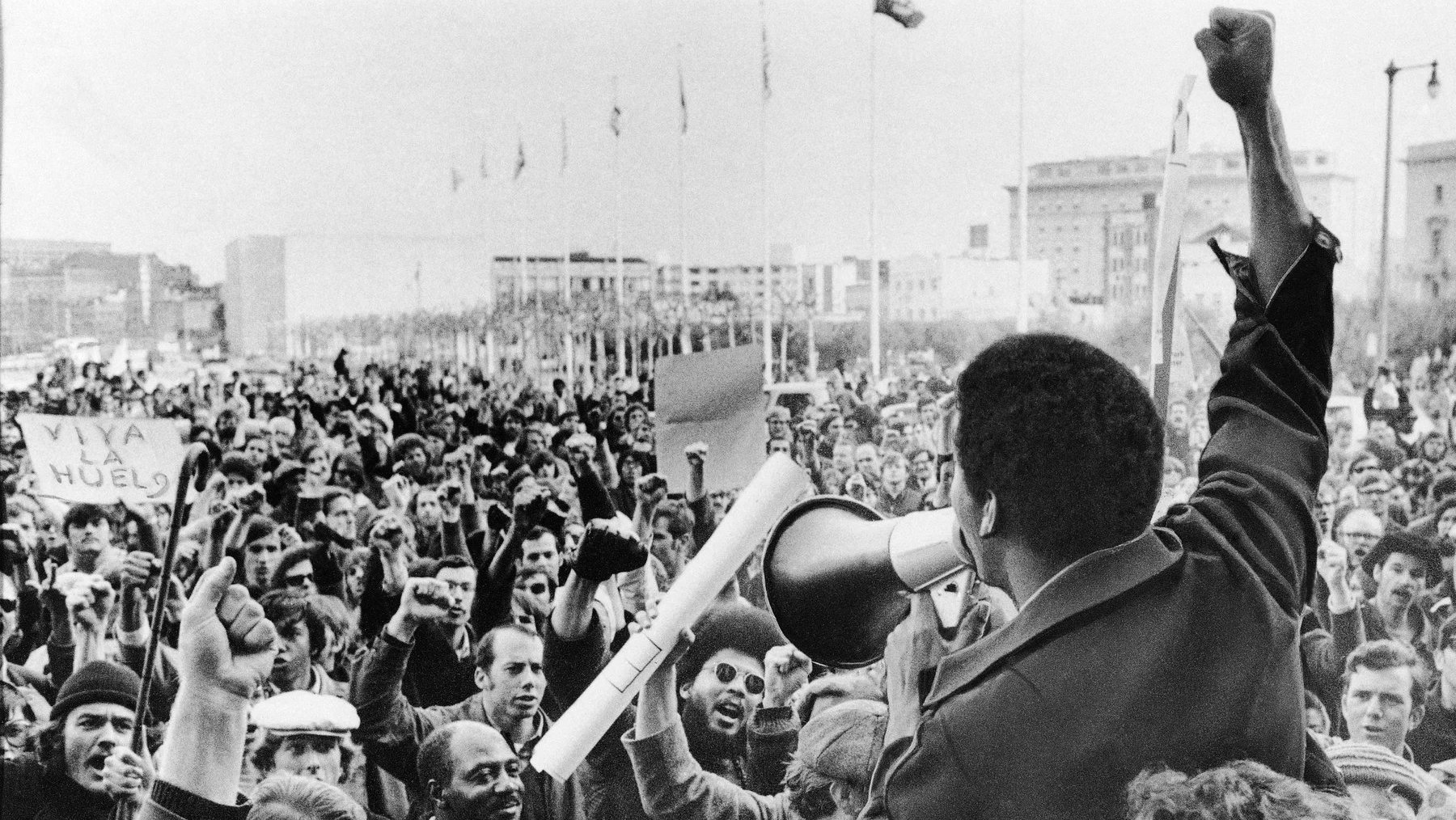
On November 6, 1968, the students of San Francisco State College (now San Francisco State University) began a strike against racism on their campus. Almost four months later it ended in educational reforms that spread across the country.
The strike was initiated by the Black Student Union (BSU) in response to the suspension of activist George Murray, a graduate student and member of the Black Panther Party. This event came after long-standing tensions between the BSU and the administration over discrimination against Black students, who were underrepresented in both student body and faculty.
The administration initially promised to allow 400 extra spots for Black students. But when Latinx and Asian students issued similar demands, they were told to share the extra slots with the Black students. The students could not accept this deal and decided to join forces: the Philippine-American Collegiate Endeavor (PACE), the Latin American Student Organization (LASO), the Mexican-American Student Confederation (MASC), the Intercollegiate Chinese for Social Action (ICSA), the Asian American Political Alliance (AAPA), and the Native American Student Organization (NASO), together formed the Third World Liberation Front (TWLF).
On the first day of the strike, 400 students protested on campus to reinstate Murray. The police responded with violence, beating the students and spraying them with mace. This incited further students to join and the protests grew from day to day.
The strike lasted until March 21, 1969, and as it grew, so did its demands: the students were able to force the administration not only to accept more students of color, but to establish the College of Ethnic Studies and hire more faculty of color. In addition, the San Francisco students inspired a similar strike at the University of California Berkeley on January 22, 1969, which resulted in the establishing of the Ethnic Studies Department.
Today, Ethnic Studies departments and courses are to be found in many campuses across the country. This is thanks to the organizing efforts of the students who formed the Third World Liberation Front, uniting organizations representing different oppressed ethnic groups and striking together.
The education system is far from equitable today, and the changes won in the 1960s and 1970s seem to pale in comparison to the remaining problems. But the student strikes of 1968-69 show us that we can make concrete changes if we are willing to organize and fight for them. While those changes may be small, they remind us of the power that working-class people can have when we fight together for a better world.