On Thursday, November 17, scholar of the people and lifelong activist Staughton Lynd died at the age of 92. Lynd was part of a generation of young scholars who came of age in the 1960s, perhaps best exemplified by himself and Howard Zinn, who sought to pursue knowledge and scholarship in the struggle to make the world a better place.
Lynd was raised in an intellectual and politically engaged family in New York – his parents, professors Robert and Helen Lynd wrote the classic sociological study Middletown – and was politically active from an early age. As a young man he joined the John Reed Club, which was linked to the Communist party, and in college he participated in two different Trotskyist groups. He got a degree from Harvard, married his wife Alice (also a scholar and activist), studied urban planning, got kicked out of the military for conscientious objection and his links to Communists, and lived on communes in rural Georgia and New Jersey for three years before returning to New York to work as a tenants’ rights organizer. He then earned a Ph.D. in history from Columbia University and began teaching history at Spelman College, an historically Black college in Atlanta. After teaching at Spelman, he joined the history department at Yale University. As a historian, he studied and wrote history from the bottom up, with a focus on the working people, the poor, and the oppressed of the world.
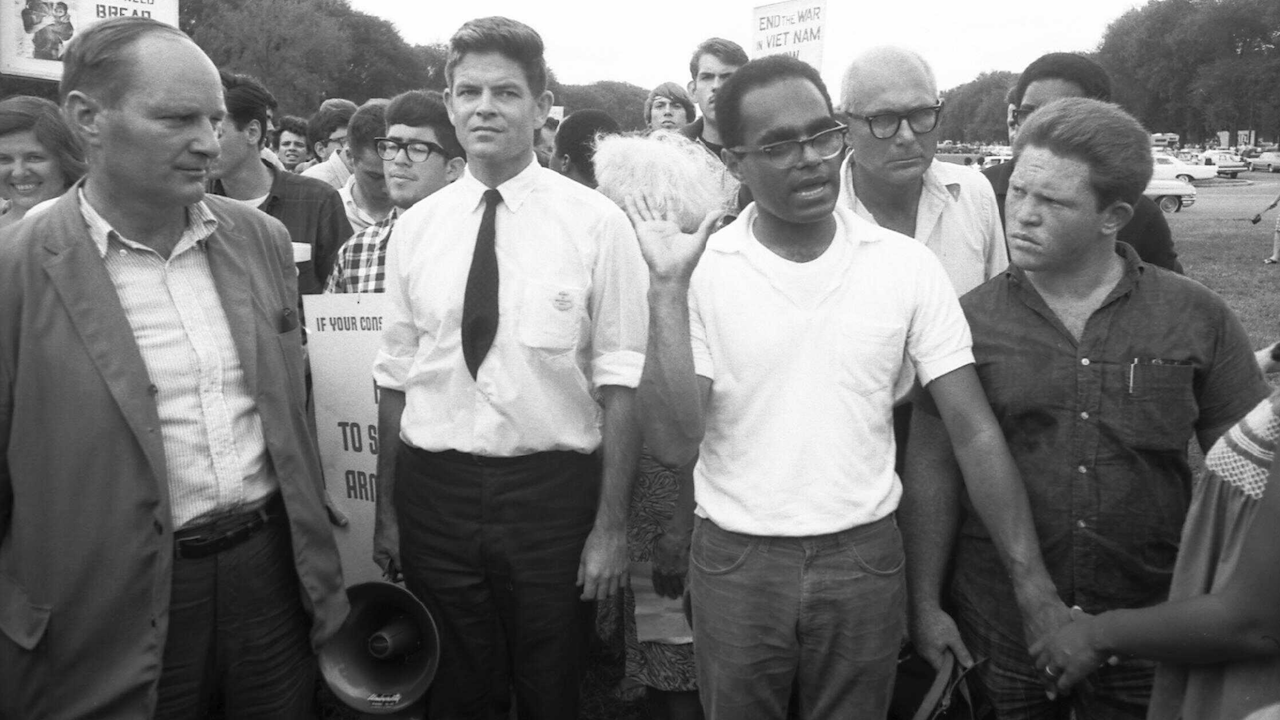
While at Spelman, he worked with historian and activist Howard Zinn, and he became active in SNCC (Student Non-Violent Coordinating Committee), and helped plan and carry out the education components of the Freedom Summer activities of 1964. He also was one of the earliest public critics of the war in Vietnam, and was an active member of the antiwar movement from 1964 on. After travelling to North Vietnam in 1966 and meeting with North Vietnamese leaders, and after publicly criticizing United States policy while outside of the country, he had his passport cancelled and was targeted by the F.B.I. At a 1965 protest (seen in the photo above) he was attacked and had paint thrown on him by neo-Nazis who supported the war.
After these activities, Lynd was blacklisted by the F.B.I. and fired from Yale. He turned his attention to full time activism, particularly helping working-class people organize themselves to defend their own interests. In this pursuit he earned a law degree from the University of Chicago in 1976, and then moved to Youngstown, Ohio, where he would spend the rest of his life as a scholar of the working class and a staunch defender of their rights and their humanity. As an activist and lawyer, he fought to defend workers and their unions from unjust treatment, against nuclear armaments and U.S. Cold War policies, against mass incarceration and the death penalty, against capitalism and international imperialism. His friend and fellow radical scholar Marcus Rediker described him as a “Marxist-Quaker… or… Quaker-Marxist?” But whatever his label or whatever issue he was working on, he believed staunchly in worker-self-activity: the idea that working people can activate and organize themselves to fight to defend their interests as a class and make change.
Lynd’s actions on behalf of working-class people, both as a scholar and an activist, showed whose side he was on in the struggle between bosses and workers, and his work remains a valuable tool for activists and revolutionaries today as we organize for a better world.
Today, from his handbooks on union labor law to his passionate writings on working-class solidarity, to Rank and File: Personal Histories by Working Class Organizers (edited with Alice Lynd and still a must-read for anyone interested in workplace organizing), Staughton Lynd’s knowledge and passion for defending working people against the deprivations of capitalism shine through to benefit us today.