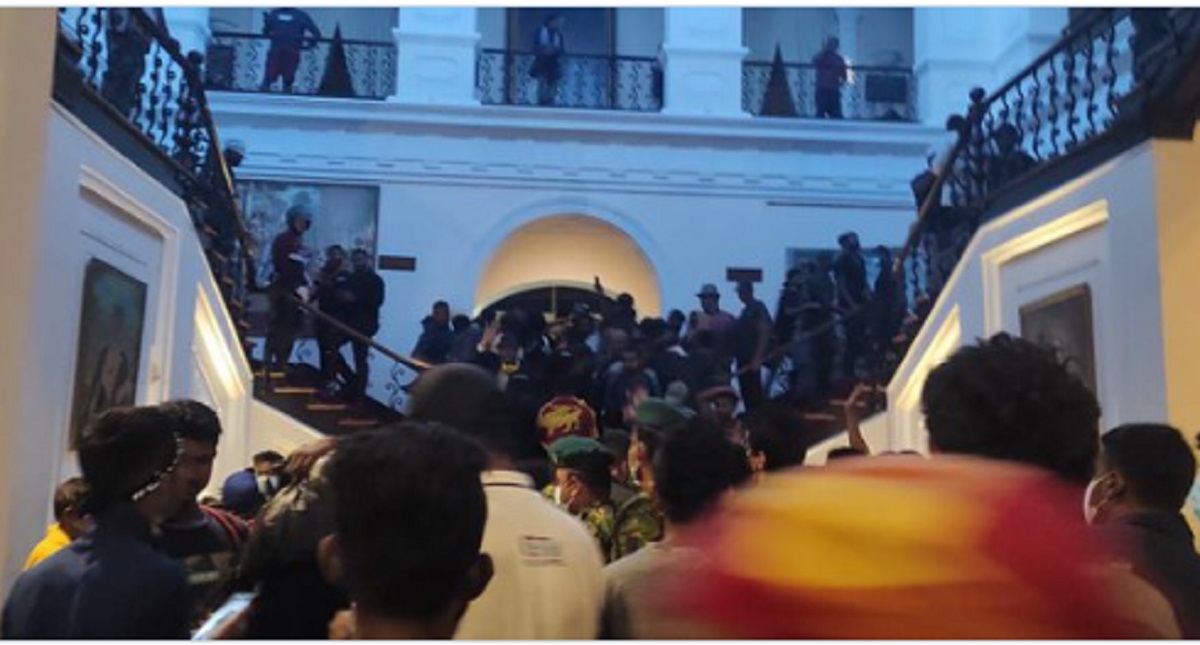
After three months of mobilizations, Sri Lankan protesters, about a million strong and surging from around the country, seized the residence of President Gotabaya Rajapaksa in a massive rebellion. A few hours later, the protesters also occupied the residence of Prime Minister Ranil Wickremasinghe. This was on Saturday, June 9. By Sunday morning, the Presidential palace, known as the Temple Trees, was occupied. Protesters and visitors were greeted by a graffitied sign at the entrance reading, “open to the public.”
The President and Prime Minister of this island nation off the coast of India have both resigned, and the President has escaped the country. They are not likely to be present on Weds., July 13, when the government meets to determine how to move forward.
The fury of this months-long rebellion is the result of Sri Lanka’s worst economic crisis ever. This crisis is part and parcel of the international crisis, with inflation sky-rocketing in many parts of the world, and profoundly affected by the war in Ukraine. In Sri Lanka, the rise in fuel prices has led to a steep rise in food prices. Difficulties in financing imports have also led to brutal blackouts and rationing. Sri Lankans have been spending countless hours waiting in line for basic goods. Workers dependent on gasoline for vehicles simply can’t work. Others are caught between needing to be at their jobs, and needing to stand in line for basic necessities.
Over the past decade, the Sri Lankan government has borrowed vast sums of money from foreign banks, the result of classic post-colonial economic so-called “development,” to fund public services. This siphons wealth toward the banks under the guise of assistance. The Sri Lankan government also cut taxes to the wealthy, claiming the need to stimulate the economy, a move that led not to economic activity, but empty government coffers. This has led Sri Lanka to default on its loans to international banks. Sri Lanka may be small in size, but it is large in its importance to the world powers, as it is one of the most important stops on the maritime trade route between East Asia and the markets of Africa and Europe. China and the U.S. are competing over domination of this island country. This crisis is one that concerns them greatly. India pledged the equivalent of $38 billion in aid to Sri Lanka in order to calm the struggle in its area of influence and the potential for the unrest in Sri Lanka to strike a chord with people in other countries around it.
The forced resignation of Rajapakse and Wickremesinghe demonstrates the enormous social power of the working class. The Prime Minister and the President have called for the formation of a unity government among all political forces. However, no government of social unity will be able to resolve this crisis. They will likely feed the population a diet of promises and dreams, hoping that the masses will go home and wait. If that fails to calm the situation, there could be a steady rain of repression, so that capitalism can go on as usual, with workers and farmers back to work and the politicians and foreign bankers benefiting. The global crisis of capitalism, leading to devastating inflation world-wide, will only end when the working population organizes itself to fight back, not just in one country, but internationally. Sri Lanka’s working people and others oppressed by the current system are showing their potential power. But the fight is global and we need to build it wherever we can.