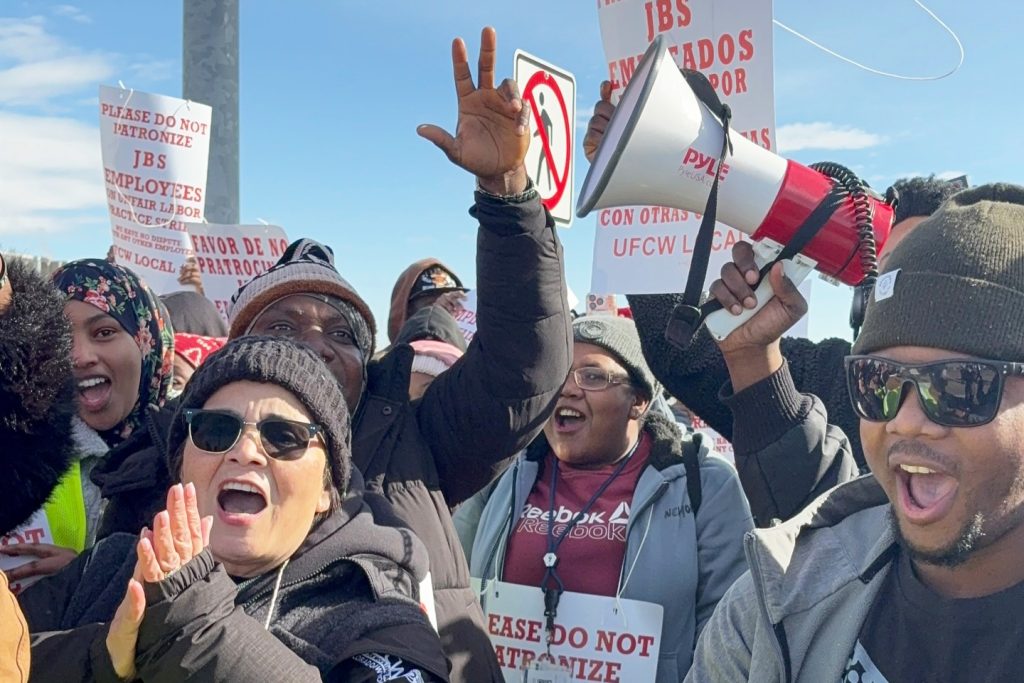
On Monday, March 16, meatpacking workers in Greeley, Colorado, began a two-week strike against Swift Beef Co. and Pilgrim’s Pride, the U.S.-based subsidiaries of JBS, the giant Brazilian meatpacking corporation. This is the first major strike in the U.S. meatpacking industry in four decades, since the hard-fought but failed Hormel strike in Austin, Minnesota in 1985. These workers, many of whom are immigrants and typically take the hardest jobs and keep their heads down to avoid attention, have our solidarity and complete support in their struggle against the JBS corporate monster.
The 3,800 workers went on strike over a number of issues. The company offered an insulting pay increase of only 2% per year over the next two years. Workers are fed up with having to pay one thousand or more dollars for their protective safety gear, which is not optional given the dangers of the job. They accuse the company of shifting more of the costs of health care onto the workers. Speedups have also infuriated workers, with accusations that the speedups have been more intense on shifts with larger numbers of recently hired Haitian workers. These Haitian workers also accuse the company of luring them to work with promises of decent, free housing, only to be charged to live in cheap local hotels. There have also been accusations of wage theft. And as most companies do, Swift/Pilgrim’s Pride/JBS also carried out an anti-union campaign in the months leading up to the contract negotiations, holding captive audience meetings with workers to intimidate them and get them to either quit the union or back down on their demands.
JBS is the largest single meat producer in the world, with slaughterhouses and packinghouses in dozens of nations. It is estimated to be worth $17 billion. It is also incredibly profitable and will likely remain so as 2025 and 2026 have seen prices for beef soar. They have also bribed officials in Brazil and used under-aged workers in their factories in the United States. The co-owner of the company has a personal relationship with Trump and the company was the largest single contributor to his 2025 inaugural ceremony. These realities make the threat of deportations even more intense, as the company could easily finger workers for removal or detention.
Despite the power of the company, these workers are standing up collectively, despite the 50-plus languages spoken in the factory and all the cultural differences that exist. Their union local, UFCW Local 7, says that 99% of its members voted to strike, indicating a high level of unity among workers in the face of exploitation and mistreatment. This solidarity is both courageous and inspiring.
But the workers face real challenges as the strike moves forward. It is not clear whether the strike will conclude after two weeks or will continue. Limiting the length of a strike in advance could constrain the leverage that workers have and allow the company to weather the strike without making concessions. It is also unclear whether the UFCW (United Food and Commercial Workers) national leadership is completely supportive of these strikers. If not, then this small grouping of workers may find themselves without the support they need at critical moments.
Another major problem is that Local 7 is the only local in the JBS system on strike. Just last year the company signed a contract with 26,000 other workers in 14 other states. This means that the workers in Colorado are alone in their strike, and that JBS will likely be able to keep total production running at something close to its typical output. These 3,800 workers are, at least for now, isolated in their struggle, without the ability to bring production to a halt throughout the JBS system. This was the major reason the workers who struck Hormel in 1985 lost their strike, and it may be a real obstacle to winning this strike.
Despite this challenge, the workers of Greeley are right to stand collectively against the JBS corporate giant and its tentacles in the United States. Their labor is harshly exploited, their bodies and health are abused, and they barely get paid enough to make ends meet. Working people in this country and around the world are exploited by the same corporations, CEOs and owners, all of whom take the value that we create with our labor and keep the profits for themselves. We stand with the workers in Greeley. Their struggle against this giant corporation is the same struggle we all face. These local and immigrant workers, despite their different languages, are fighting together and setting an example for working people in the U.S. and around the world.