“How can you ask someone to live in the world and not have something to say about injustice?” – John Carlos
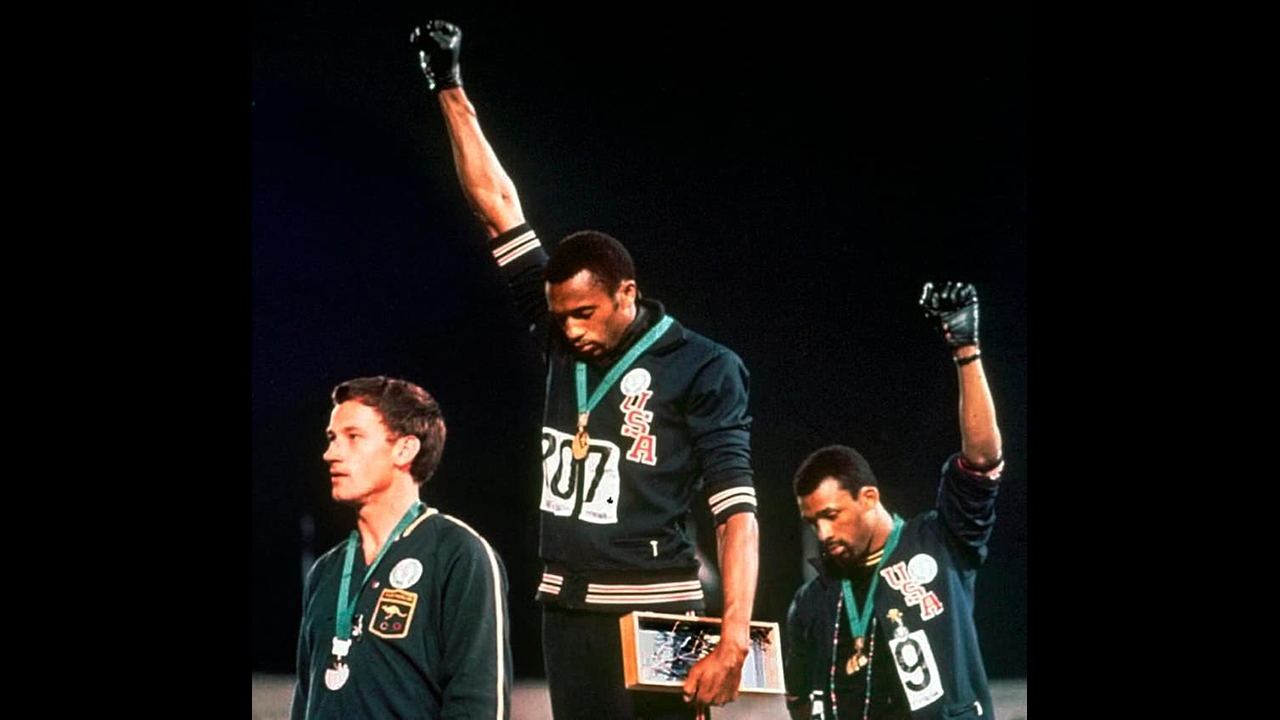
Mexico City, 1968: two black gloved fists are raised in the air during the awards ceremony for the 200-meter sprint at the Olympics, as the U.S. National Anthem. Tommie Smith and John Carlos, two Black athletes representing the United States, raised their fists in protest of the deep racism that Black people in America faced. They stood on the podium shoeless to represent the terrible poverty in inner cities. Their protest was electric and sent shockwaves around the world; the picture of their protest has since become a defining image of the 1960s.
But it shouldn’t have come as a surprise. 1968 was a year of massive upheavals and rebellions across the world, a culmination of the preceding years of activism and organizing. In the U.S., 1968 witnessed the assassination of Martin Luther King, setting off huge riots across the country. In August, at the Democratic Convention in Chicago, anti-war protesters were brutally beaten by Chicago police and eight of the protest organizers, including Black Panther Bobby Seale and student leaders Abbie Hoffman and Tom Hayden, were charged with inciting a riot. In France, May 1968 saw massive student protests joined by seven to ten million striking workers – over a fifth of the country’s entire population!
And in Mexico, where the Olympics were being held, Mexican students had been organizing throughout the spring and summer for democratic rights, control over their education, and against the semi-dictatorial PRI party which had controlled the government for over four decades. During a student protest in Mexico City on October 2, 1968, ten days before the Olympics were to begin, Mexican police and armed forces opened fire at the crowd of 10,000, murdering upwards of 300 protesters and injuring a thousand more. The Mexican government acted quickly to cover up the massacre, and to avoid any negative publicity before the start of the games.
Smith, Carlos, and Peter Norman (the third winner of the 200-meter race who wore a human rights pin in solidarity with Smith and Carlos) paid a steep price for their heroic activism. Sports commentators and media outlets across the US denounced them, with time magazine saying they had changed the Olympic slogan from Faster, Higher, and Stronger to Angrier, Nastier, and Uglier. Future ESPN commentator Brent Musburger compared them to “Black skinned storm troopers.” The International Olympic Committee kicked Smith and Carlos off the American Olympic team and sent them home. Peter Norman, meanwhile, was blacklisted from the Australian Olympic team of 1972, despite qualifying 13 times over.
In the summer and fall of 2016, 48 years after Carlos and Smith raised their fists, SF 49ers quarterback Colin Kaepernick took a knee during the National Anthem before the beginning of football games. Like Carlos and Smith before him, he was protesting the racism and violence in American society that condemns Black people to poverty and police violence. And also, like them, Kaepernick faced reprisals and was blacklisted from the NFL, and still has yet to be signed on with another team four years later.
More recently, after Jacob Blake, a Black man in Kenosha, Wisconsin, was shot seven times in the back by police at point blank range, the Milwaukee Bucks and refused to play in their playoff game against Orlando Magic in protest of the endless police shootings. Their protest spread throughout the NBA and then to other leagues. Multiple MLB games were cancelled, the WNBA demanded their season be cancelled in solidarity, and the NHL and Major League Soccer organized similar protests.
The problems that John Carlos and Tommie Smith raised their fists against in 1968 are still with us today. Black people and people of color still face de facto segregation in schools and neighborhoods and continuous police violence. Workers face perpetual poverty, which falls hardest on people of color. But if Carlos and Smith show us anything, it’s that we can fight back. We’re the only ones who can. We’re the ones who have to organize against the exploitation and racist injustice inherent in our capitalist system.