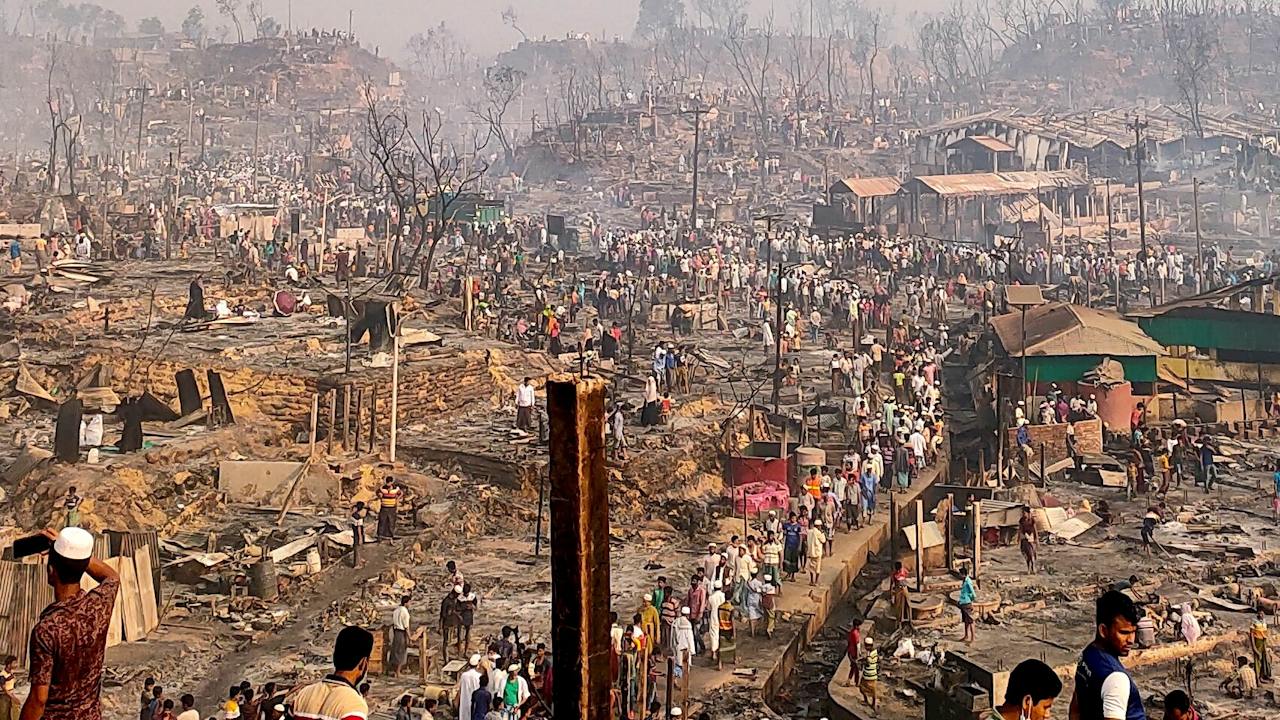
Tragedy struck on March 22 as a massive fire destroyed large parts of the biggest refugee camp in the world in Bangladesh. The Kutupalong refugee camp in Cox’s Bazar, Bangladesh is a massive refugee camp near the border of Bangladesh and Myanmar. It is home to roughly 900,000 Rohingya Muslim refugees who have fled genocide in Myanmar. Due to an intensification of violence in Myanmar against the Rohingya people, the refugee camp has ballooned in population in the past few years. Fleeing a campaign of murder, rape, and arson led by Myanmar’s military against the Rohingya, approximately 730,000 Rohingya have settled in the camp since 2017.
Conditions in the camp are extremely cramped as informal slums have grown rapidly to house the refugees. These conditions allowed the fires to spread so rapidly. According to the United Nations, the fires killed 15 people while destroying the shelters of 45,000 people who are now displaced. The true numbers are likely significantly higher, as the U.N. has acknowledged that at least 400 more people are missing, likely killed in the fires.
Refugees in the camp described witnessing people burned alive as the fire quickly overtook 250 acres of the camp. Marium Kahtun, a Rohingya refugee, told the Guardian, “we’ve lost everything once in Myanmar. We came to Bangladesh and started over. Now I’ve lost everything once again…I don’t know what will we do now.”
This fire and the treatment of refugees like the Rohingya people is part and parcel to the system of capitalist imperialism which views refugees as expendable people. The brutal treatment of refugees is not just a problem in Bangladesh. The capitalist system internationally destroys people’s lives and forces them to flee their country of origin to survive. We need to look no further than the current situation at the United States’ southern border, where thousands are fleeing poverty, violence, and climate disruption in order to try to have a better life in the United States. Giant corporations based in the U.S. have exploited Central American countries for more than a century to control the markets on bananas, coffee, and other resources, all at the expense of the people who live there. Similar imperialist exploitation has devasted people’s lives in Myanmar, Bangladesh, and all over Asia, Africa, and Latin America.
Only by ending capitalism will we be able to begin to address the root causes of migration, and create a global system that treats everyone with dignity instead of treating them as worthless and expendable.