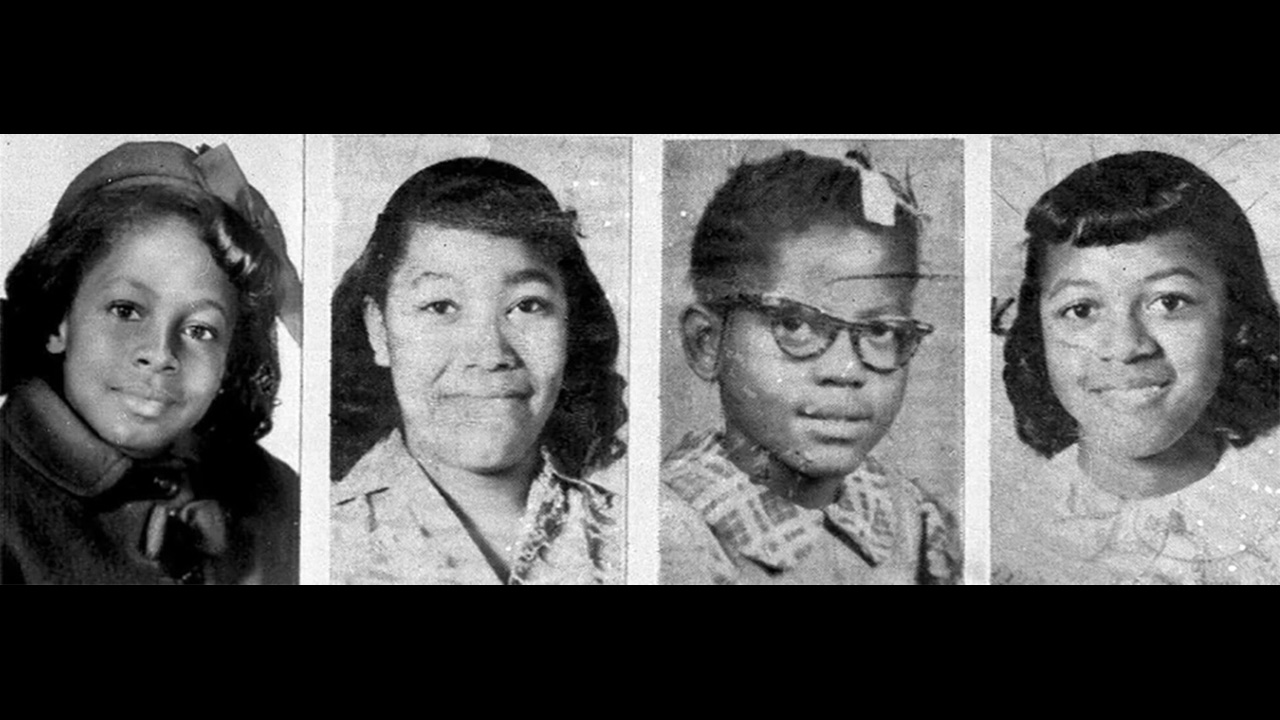
On Sunday, September 15, 1963, a bomb blast shattered preparations for church service in the 16th Street Baptist Church in Birmingham, Alabama, injuring dozens and killing four Black girls ages 11-14. The now infamous bombing showed the heinous nature of the racist structures that had been set up during the Jim Crow era, and the tenacity of the resistance to changing those structures. It was also only one part of a long and painful Black struggle that was met consistently with brutal violence from the white power structure.
The bombing was a shocking moment for many in the United States. Not only was the site of the violence a church at the very time of a religious service, but the victims were young girls. The killing was one of many events that slowly shifted the views of many whites from one of hostility to Black freedom struggles to one of at least some degree of sympathy. It also added to the pressure on politicians to limit overtly racist violence, hoping to make reforms to the system that would dampen down the movement of Black and poor people that was swelling in the U.S. at the time.
But as horrific as it was, the bombing and deaths of these four little girls was only one instance in a series of violent episodes in the city and nation. Birmingham had long had an active branch of the Ku Klux Klan, the racist terrorist group that was often funded by local business interests and tightly interconnected with local police departments and officers. In the same period after World War II, both Montgomery and Birmingham (Alabama’s two biggest cities) were becoming centers of the Black movement against Jim Crow repression. Conflict was inevitable.
A pattern had developed of Black action and demands for change followed by violent responses by local officials and Klan groups. Even before the 16th Street Church bombing, the city had already earned the nickname “Bombingham.” One neighborhood in particular, which had seen at least 40 separate bombings between the mid-1940s and mid-1960s, was nicknamed “Dynamite Hill.” Bombings and drive-by shootings were the norm in that neighborhood, intended to intimidate Blacks who moved into the white neighborhood, to punish people who were openly active in the movement, and even to punish a local hotel that allowed Martin Luther King to stay there. Some residents had walls built around their small properties to protect them from bullets that came with regular drive-by shootings.
These events intensified after May of 1963, when the famous Birmingham Children’s Crusade took place, in which over the course of one week more than 1,000 Black children marched and were met with police dogs, high pressure firehoses and the jailhouse, operated by the openly racist Sheriff “Bull” Connor. The church, a staging ground for the student organizing for the crusade and a space for movement organizing in general, became a target.
After that, the forces of racism became even more violent in response. To give just one example, in the months leading up to the church bombing, an attorney for the N.A.A.C.P. had his house bombed twice, had it shot up on more than one occasion, and his wife found an undetonated bomb in her garden. This was low-level guerilla warfare against the Black community. The September 15 bombing was simply the most sickening in a long line of consistent attacks on Blacks in Birmingham.
The racist white elements of Jim Crow society operated with the complete support of the business community and local and state government to suppress the Movement. It was in this context that a group of three Klan members, supposedly concerned that their local East Birmingham K.K.K. leadership and law enforcement officials weren’t doing enough to crush the Black movement, hatched the plan for the bombing. While these were the only three ever directly connected by the authorities to the crime, they cannot be viewed as lone extremists acting outside the norm. They were shaped by and completely supported by the longstanding Jim Crow power structures that shaped their entire world. They were reinforcing the longstanding racist society that was designed to keep Black and working people in their place.
Racist oppression in the U.S. has been present since its first decades and has continued with great violence. Racist violence continues as a normal part of capitalist society. All we need to do is say the names Eric Garner, Ahmaud Arbery, Breonna Taylor, George Floyd, Freddie Gray, and others, to remind ourselves of that. The 16th Street Church bombing and the deaths of these four young girls carried out by these three men and sanctioned by the larger Jim Crow society is one of a long list of events reminding us of the violence of racism in the history of the United States. It is a normal part of the way our system works.
Today, September 15, we remember Denise McNair, Carole Robertson, Addie Mae Collins and Cynthia Wesley, the four girls whose lives were cut short by this racist bombing. At the same time, we rededicate ourselves to moving beyond the sick society in which their murders were allowed and encouraged.