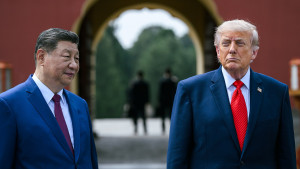
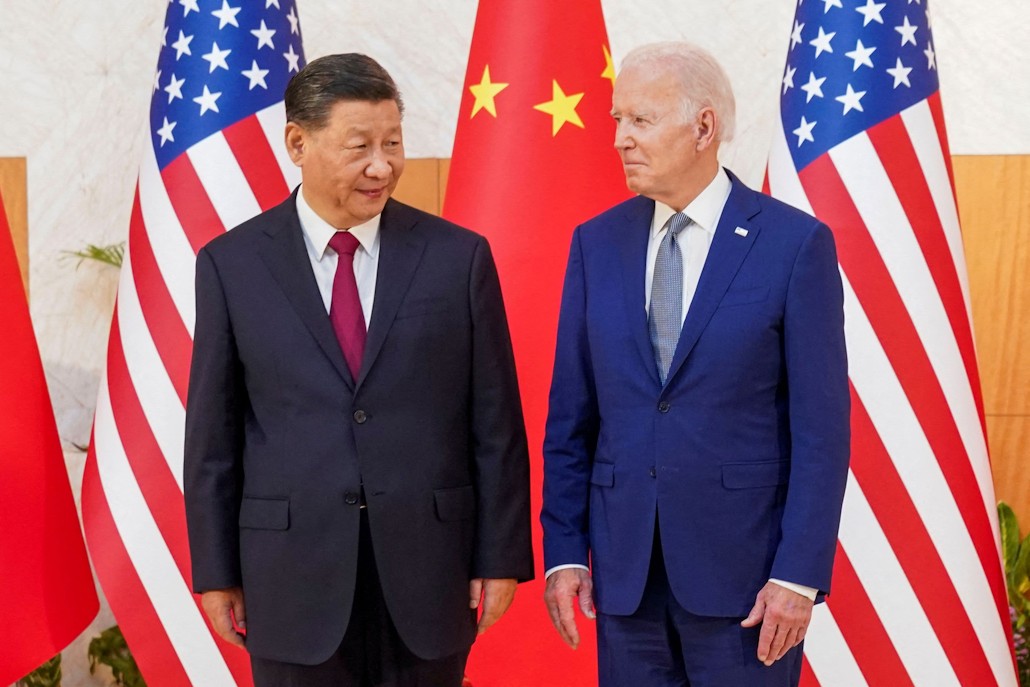
On November 14, U.S. President Joe Biden and Chinese President Xi Jinping held a three-hour talk in which they sought to “manage” the two countries’ different interests. The two politicians represent two of the world’s most powerful capitalist economies, and all throughout the world, competition for markets and resources drives the U.S. and China towards a state of conflict. While the two politicians discussed how China and the U.S. can avoid coming into dangerous military conflict, the system itself guarantees conflict, and it is insane to believe this conflict can be “managed.”
For years, the U.S. has seen an increased state of conflict with China, with little to no change in policy between former presidents Trump and Obama, and the current presidency of Joe Biden. The U.S. has had long-standing interests in economically and militarily dominating Southeast Asia, where U.S. capitalists have found a wide field for investment, the employment of cheap labor, and the sale of goods. For decades, U.S. policy has used their military presence as well as economic pressure to ensure that U.S. corporations are able to operate in the region and make a profit. With Obama’s second term in 2012, he announced a “pivot to Asia”, strengthening the U.S. military presence, and diplomatic and trade relations in Southeast Asia.
U.S. goals in Asia clash with the aspirations of China to leverage its growing economic power in the region and throughout the world. China’s “Belt and Road Initiative” announced in 2013, for example, would create transport infrastructure across the Eurasian continent, connecting 150 countries. This coincides with a growth of Chinese industry and competition for markets and investments dominated by Western powers in the past. Chinese president Xi Jinping is known for and associated with this policy of economic expansion. In 2020, China’s foreign investments topped $153 billion, the most direct foreign investment of any country in the world. By 2020, some 80 percent of countries and regions around the world had received investments from China.
During Trump’s presidency, the U.S. responded to Chinese economic expansion with tariffs and trade barriers to limit Chinese access to markets. This aggressive move set off a trade war between the two countries, which has not ended with the Biden administration.
Like the U.S., China’s economic power is accompanied by the threat of military force. China’s military budget, though far below that of the U.S, has expanded every year for the last decades. The South China Sea is the site of increased Chinese military presence. Built into this militarization is a historic conflict.
The Chinese government, since the 1949 Chinese Revolution, has considered Hong Kong and Taiwan to be Chinese territory. These territories were, indeed, taken from China as colonies by the British and the Japanese during the first half of the 20th century. In the last decade, China has extended its political and military control over Hong Kong, but Taiwan remains independent of Chinese control. Therefore, Taiwan is not only a strategically important location, but control over Taiwan is an important nationalist symbol for the Chinese government. The U.S. has seized on this conflict, and for decades has signaled that it would oppose a Chinese takeover of Taiwan, with military force.
The economic, strategic, and territorial conflicts between the U.S. and China are a minefield of possible explosions. The system of international capitalism throws both major powers into a state of competition and conflict, and any flashpoint could be the origin of a global conflict. Xi and Biden may pretend that, for the moment, these tensions can be solved by open agreement, but the situation remains exceptionally volatile.
The famous military strategist, Carl von Clausewitz, once said “War is a continuation of politics with other means.” It is the working class and poor of the world who suffer when politicians such as Biden and Xi can’t solve their differences by diplomacy, and so they turn to war as a means to solve them. We can hope, in the near future, that this won’t happen. But the only guarantee of ending the threat of war in the long run is to put an end to the system of international capitalist competition which creates these conflicts that lead to war.