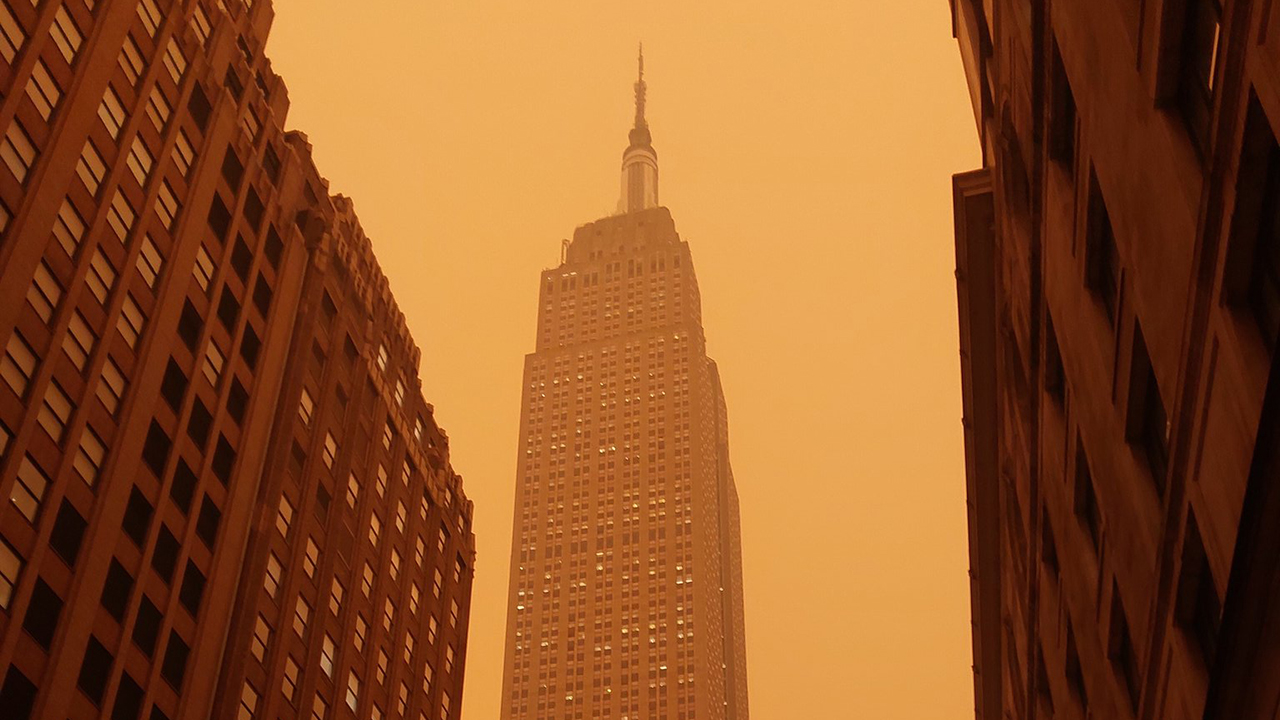
On Tuesday, June 6, the afternoon air in the New York City metro area was hazy with a slight smell of burning. On Wednesday, June 7, as the day wore on, that haze and smell became an ominous blanket that darkened the sky, then turned it a bright orange, and became noticeable in the eyes, noses and mouths of pedestrians. People again put masks over their faces, this time to avoid the granular feel of the air as they tried to breathe. Hundreds of flights in and out of airports in the New York area were cancelled. The smoke moved inside wherever it could, filling the atrium of a high school in Newark, where students who had discussed global warming and the forest fires of the past few years in their class ran to their teachers’ classroom to say, “we just talked about this!”
After the E.P.A. air quality index (AQI) reached a record high of over 400 (when anything over 300 is considered “hazardous,” while anything over 100 is considered “unhealthy”) school was closed for millions, millions more stayed home from work, and non-essential outdoor activities ground to a halt. It quickly became clear that no one, no region, no city, was immune to the worsening effects of climate change. The nation’s largest city, 8 million people, was suddenly at the mercy of nature in a changing world.
The giant clouds of smoke came from the more than 420 separate wildfires burning in Canada, many on the East Coast provinces of Quebec, Ontario and Nova Scotia. Canada, like the United States, had far less snowfall than usual this year. That was followed by a dry spring, with only one-third of the normal rainfall in Nova Scotia. This created the dry, hot conditions that allow human error or lightning strikes to go from a small fire to a massive, destructive blaze.
As global warming continues and worsens, due directly to the burning of fossil fuels, these events will happen repeatedly, and get increasingly worse. No matter where we are, how sophisticated the city we live in, how large and dense the metropolitan region, we can’t escape climate change.