I went back to Pakistan, for the first time in seven years. After I landed I went to the money exchange. There I was handed a big bundle of Pakistani rupees, for merely five hundred U.S. dollars. I realized that I would have no problem having a comfortable two-week stay in Karachi, as a visiting U.S. citizen.
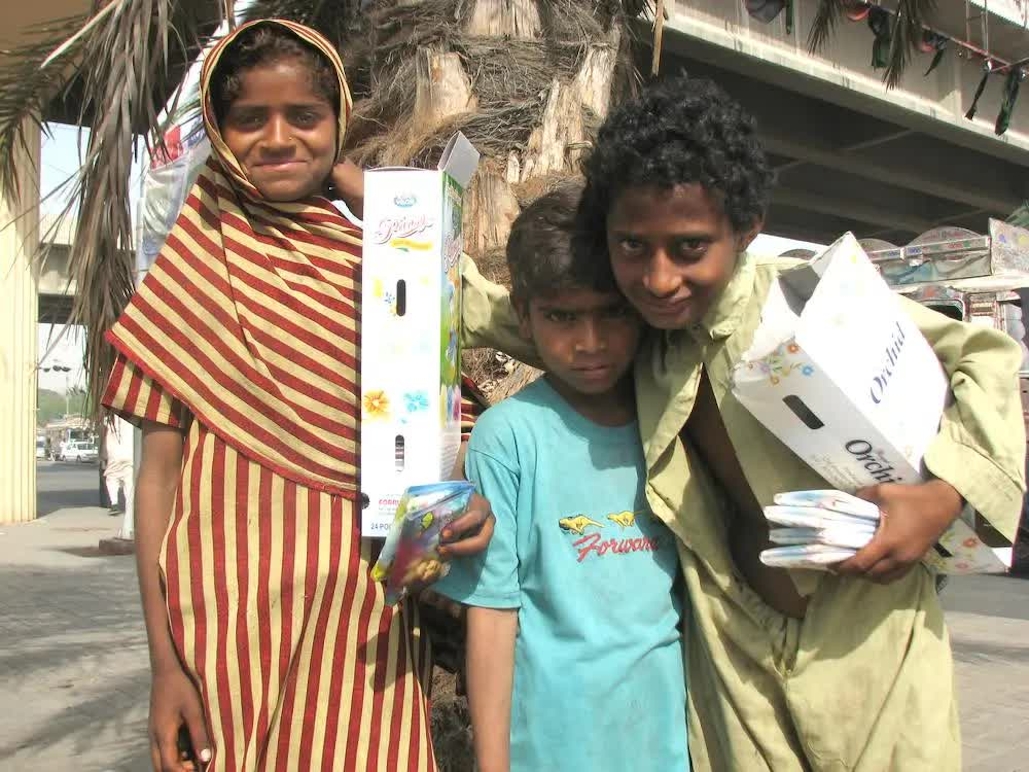
Karachi is one of the most important cities in Pakistan, not only because of its size and population, but also because of the role it plays as the country’s financial hub. People come there from around the country looking for job opportunities; it is the New York City of Pakistan. Despite being the economic hub, this city is full of people with unfulfilled dreams and unmet needs. Compared to 2014, which was the last time I was there, I noticed an increase in the number of children on the streets begging for money and food. The comparatively fortunate ones were able to sell small items such as flowers, masks, or socks in the middle of infamously dangerous and hectic traffic. These children would never get to experience a ‘normal’ childhood. Economic conditions are not easy for adults either, especially young adults. I had a brief conversation with one of them. He told me that even though he had completed his education, he was unemployed and had to sell masks in the streets to pay for his mother’s hospital bills. There are many such examples of young people struggling to keep up with the recent wave of inflation.
Those who have lived in Pakistan for a very long time told me that this is not the first time that Pakistan has suffered through economic hardship, but it is definitely one of the worst periods they have witnessed. Pakistan is in a classic debt trap, a victim of both the International Monetary Fund (IMF) and the Chinese regime. The IMF has introduced unfair policies, such as demanding higher taxes, in exchange for the money they loaned Pakistan about three years ago. Furthermore, Pakistan’s location, bordering China, puts it in an economic chokehold, which has gradually increased over the last decade. China provides Pakistan with emergency loans, and has also temporarily taken over ports and industries to satisfy its greater economic interests. The consequences of these actions by the IMF and the Chinese regime have fallen on the shoulders of the Pakistani working class and poor.
The current government of Pakistan has repeatedly given a worn-out, classic statement to explain this economic downfall: “we are only trying to fix the mess that previous governments made,” which, in terms of assigning blame, is not entirely false. The previous governments also secured loans from foreign institutions, further increasing the country’s debt. The current government’s claims that they are trying to ‘fix’ anything could not be further from the truth. The Prime Minister’s advisors and ministers include capitalists who have businesses, both in Pakistan and abroad, and they have been caught in multiple offshore company scandals.
When it comes to the COVID-19 pandemic in Pakistan, the popular narrative inside the country seems to be that Pakistan is one of those ‘lucky’ places in South Asia, which has not faced the worst-case scenarios of the pandemic. Many people I spoke with credited God for saving them from the Covid disaster; others mentioned Pakistan’s mostly young population as one of the reasons why it remained comparatively safe from the worst of this pandemic. As I travelled and spoke with workers, I realized that a lot of them had no choice but to go against all the Covid precautions, and continue working so that their families could survive. In addition, there was a lot of misinformation on social media apps, predominantly Facebook, that unfortunately convinced a large portion of the population that COVID-19 was merely a hoax. A lot of people also said that this pandemic was just one more of the government’s schemes to make money off of them. Even though the government provides some free vaccines, it is not nearly enough for Pakistan’s 221 million people. Private companies have imported vaccines, even Pfizer vaccines, but they only sell them to the highest bidders. The government pretended to regulate the private companies, but the private companies got the last say.
Despite meeting many relatives and enjoying my time in Pakistan, I could not help but think about the privileges I enjoyed because I was visiting as a U.S. citizen with U.S. dollars to spend. I was able to get my COVID-19 test done at my hotel before flying back to the U.S. because I could afford to pay for it, something a Pakistani working-class family would never be able to afford. My trip made me understand even more deeply the inequities of a world dominated by global capitalism, and why we need systemic change.