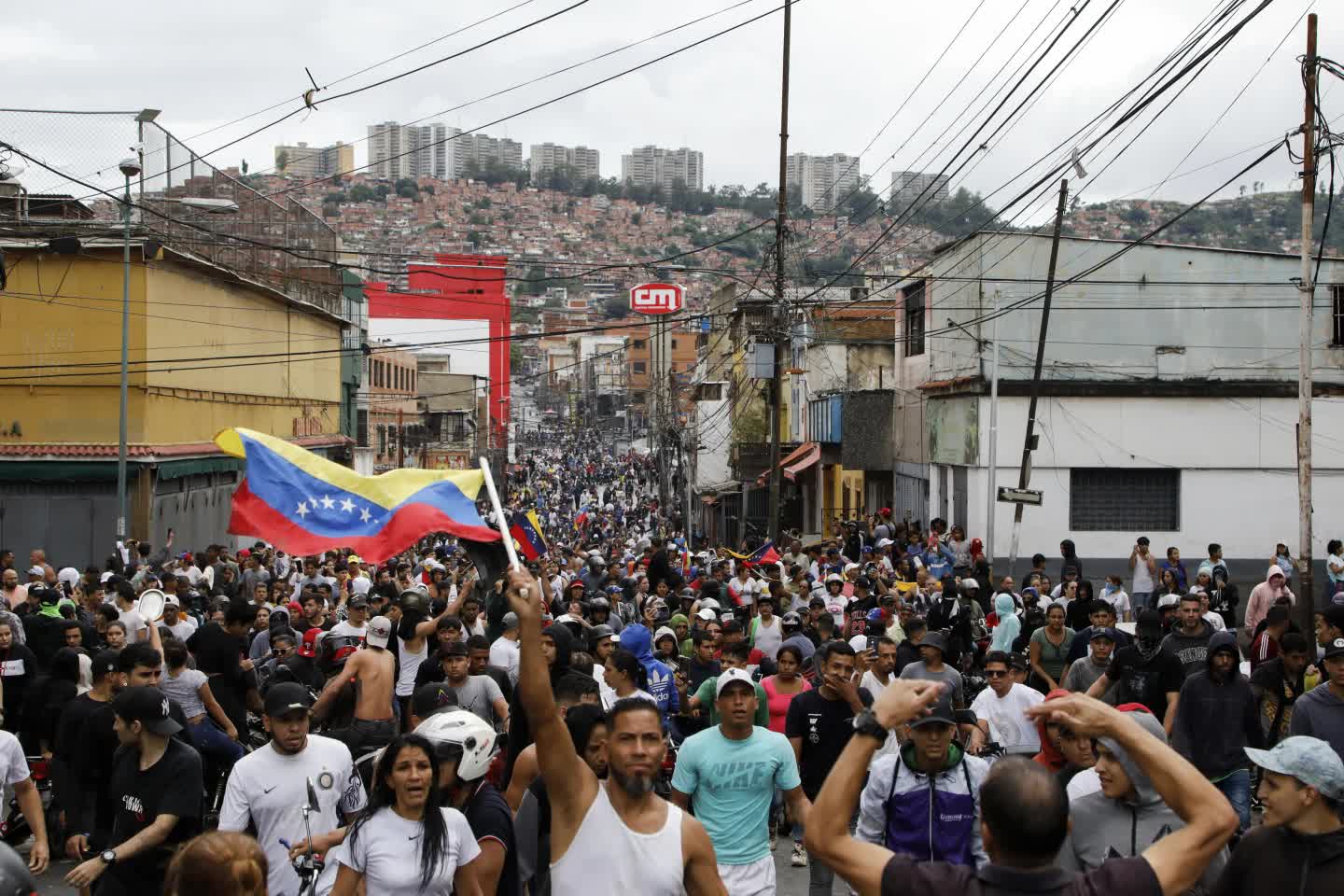
Venezuelan President Nicolas Maduro has been president since 2013 and has ruled in authoritarian fashion since at least 2015, when the legislature dominated by his party gave him the power to rule by decree, and after supportive rulings from Venezuela’s Supreme Tribunal. Despite spells of mass protest and at least one attempt to create an alternative government by opposition forces, he and his party have clung to power despite lacking the popular support that his predecessor, Hugo Chavez, had cultivated. On July 28, Venezuela held its latest presidential election, immediately after which opposition claims of fraud and repression opened the door to dueling protests, arrests and violence, and now a boiling political crisis.
The opposition, which is a coalition of parties and groups that oppose Maduro, is led by a center-right grouping that is firmly allied with the imperialist interests of the United States. This wing is led currently by Maria Corina Machado, the daughter of a Venezuelan steel company executive whose company was expropriated during the Chavez government. She has been connected to Republican politicians in the U.S. and other forces on the international right for decades, and has recently called for U.S. military intervention in Venezuela. She has also openly stated that she will leave socialist ideas behind, that the country must open itself further to market forces, and that she would privatize PDVSA, the state oil company. Her words fit perfectly with the goals of Washington, the big oil companies and the rest of the big capitalists. It’s no surprise that they support her movement for so-called democracy.
Maduro and his party, the United Socialist Party of Venezuela, grew out of the left-populist nationalist movement of his predecessor, Hugo Chavez. Because of his reforms to the state oil company that allowed the government to funnel more of the profits towards social needs, Chavez had significant popular support. But despite his popularity and the fact that he did easily win regular elections, his regime did rely on corruption and at least some degree of intimidation and repression of opponents in order to stifle dissent. In this way, his government was not much different than many governments in Latin American history. It was this partly democratic, yet partly repressive apparatus that Nicolas Maduro inherited in 2013, and has used ever since to solidify his more and more authoritarian control over the state apparatus. His regime has relied more and more on corrupt use of state funds to support the profits of a national capitalist class inside Venezuela, while workers still struggle to survive. That is not socialism.
The United States and other foreign actors have, of course, only made things worse. These forces obviously wanted first Chavez and now Maduro gone. They want not only to open up Venezuela’s huge oil reserves to profitable exploitation, they also want to break up state control of the one economy in Latin America that has been mostly closed to foreign companies since the Chavez years. Through more than 20 years of on-and-off, recently intensified sanctions on Venezuelan companies, financial dealings, and oil, the U.S., the Organization of American States, and other foreign actors in alliance with big capital have worked hard to weaken the Venezuelan state and squeeze Maduro out of power. In doing so, they have made an already unequal capitalist economy an even worse disaster, driving millions to emigrate, desperately seeking better lives.
All three political forces just described – the oppositionists aligned with international capital, the authoritarian and so-called socialist Maduro, and the military and economic power of United States imperialism – are all part of the problem and three enemies for the Venezuelan people. Maduro is a typical authoritarian leader who relies on anti-imperialist rhetoric and nationalist and socialist phrases to win enthusiasm and support despite maintaining an unequal capitalist political economy that doesn’t work for millions of working Venezuelans. Machado and the United States are even worse, and would rip away any shreds of protection for working people, leaving them at the mercy of international capitalist interests that don’t care about Venezuelan workers. It’s no wonder many still support Maduro and the Chavez heritage he claims. In this context, with these forces in competition with each other, the Venezuelan people have little reason to be hopeful.
But the millions of poor and working-class Venezuelans do have one thing they can rely on: themselves. There are about 28 million people in this resource-rich nation. As in all modern capitalist nations, the majority are working-class, many of them poor and desperate. As here in the U.S., they do the work and they have the power, if they can organize to use it.