
Recently in a 60 Minutes interview, President Joe Biden escalated the risk of war with China by stating the U.S. would intervene militarily if China tried to invade and take control of Taiwan. This is the latest in a series of events and threats that could lead to a major war.
For background, the political status of Taiwan has been contested since the Chinese Revolution of 1949, when the Chinese Communist Party led by Mao Zedong gained control of the mainland, forming the People’s Republic of China (PRC) which still exists to this day. During the revolution, the former government of the Republic of China (ROC) – the name of the country before the revolution – led by the Kuomintang (KMT, Chinese Nationalist Party), fled to the island of Taiwan and took control over the island.
After the revolution, the U.S. capitalists and their government initially supported Taiwan and the KMT, recognizing it as the “real China.” They did this as they viewed Taiwan as a reliable anticommunist outpost against the new regime of the PRC and any potential alliance they would form with Soviet Union.
However, in 1971, the United States moved to established diplomatic relations with the PRC in an effort to cultivate economic relations with the country and access Chinese labor at low wages for U.S.-based companies.
In doing this, the U.S. government was forced to recognize the PRC as the official state of China, and adopted a policy of “strategic ambiguity” toward Taiwan. This policy, meant to appease the PRC regime, stated that there was “one China,” and that the political status of Taiwan was ambiguous. Despite this, the U.S. government retained economic and military ties to Taiwan while recognizing the PRC.
Since then, a hallmark of U.S. foreign policy has been the policy of so-called “strategic ambiguity” – meaning they would maintain support and ties to Taiwan but never formally declare it a separate country, and would never state whether or not they would support Taiwan in a military conflict with the PRC.
Biden’s recent comments may represent a shift in U.S. policy as military tensions have ratcheted up between the U.S. and China. A critical factor is that Taiwan is the largest producer of semiconductors in the global economy, meaning the powerful American tech sector and larger economy are almost completely reliant on the Taiwanese technology for their profits and power.
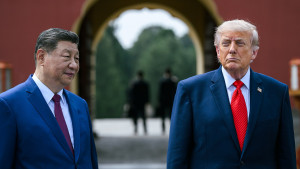
In his interview, Biden stated that the U.S. would defend Taiwan in an attack, which angered the Chinese regime. Earlier, when asked about U.S. military support for Taiwan, PRC president Xi Jinping stated that “those who play with fire will perish by it.”
This may be a significant new step in the military tensions between the U.S. and China, who seem to be on a collision course for war in the future. Such a conflict between two superpowers would bring chaos to global society and raise the threat of nuclear war. This is a dangerous provocation by Biden, and the situation will only get more tense as competition between the U.S. and China for domination of the globe continues to heat up. The threat of war it implies would be catastrophic for everyone in the world.