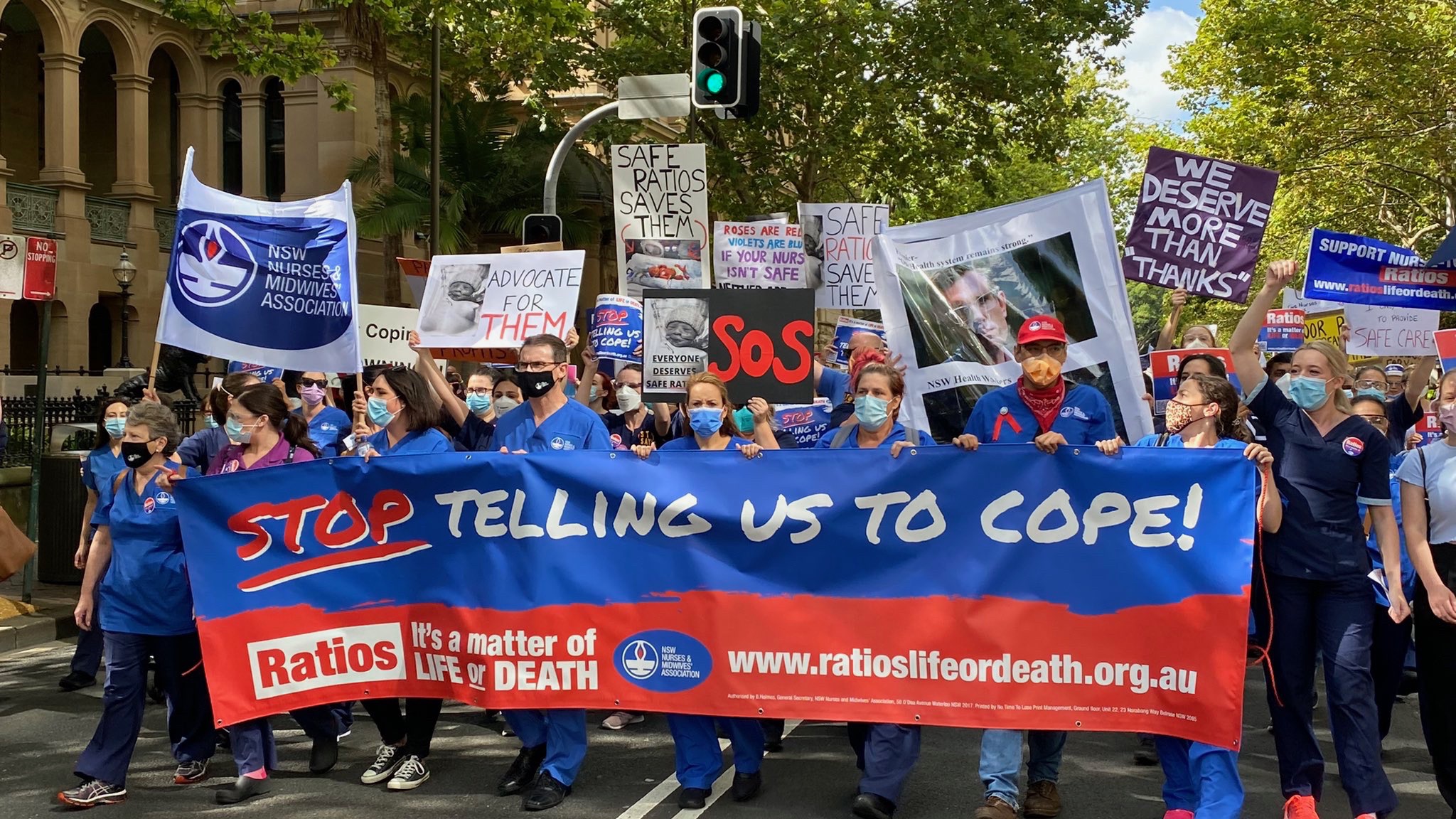
Last week, thousands of nurses across roughly 150 hospitals went on strike in New South Wales, Australia. Nurses are demanding a ratio of one nurse for every four patients and a pay increase of 2.5% above what the government offers in the public sector.
For nurses and healthcare workers, as for many other workers involved in care work, the choice to strike is not an easy one. It is never easy to leave the patients that they work so hard to care for. But the years of horrible working conditions have pushed people to take drastic measures.
One Labor-and-Delivery nurse explained that her hospital doesn’t count the babies that they care for into their ratio, so they might have up to 13 patients at a time, counting both moms and babies. A medical floor nurse talked about patients missing out on medication passes, washing, and medical assessments, and said that during night shift they can have up to 10 patients per nurse. Another nurse said that in 45 years of being in the field, she had never seen the staffing conditions so bad. And another nurse talked about how insistent the hospitals are to get people to work overtime instead of hiring new staff. Some people are called during sick leave and even maternity leave.
These stories will sound all too familiar to those working in healthcare in the U.S. We have also seen how the for-profit healthcare model exploits healthcare workers. It is no secret that the largest budget item for healthcare companies is wages, so here in the U.S. as elsewhere, hospital administrators strive to pay the least while making workers do the most. These nurses and midwives in New South Wales defied the ruling by the health department that argued that the strike would put public health and safety at risk. These nurses know it is the government who for years has been risking patient safety by ignoring healthcare workers’ demands for safe staffing and proper pay.
Healthcare workers across the world need to learn from these lessons. The bosses will not change the way they operate, because their priority is to protect the bottom line. It is up to us to create a safe healthcare system that protects workers and patients.