
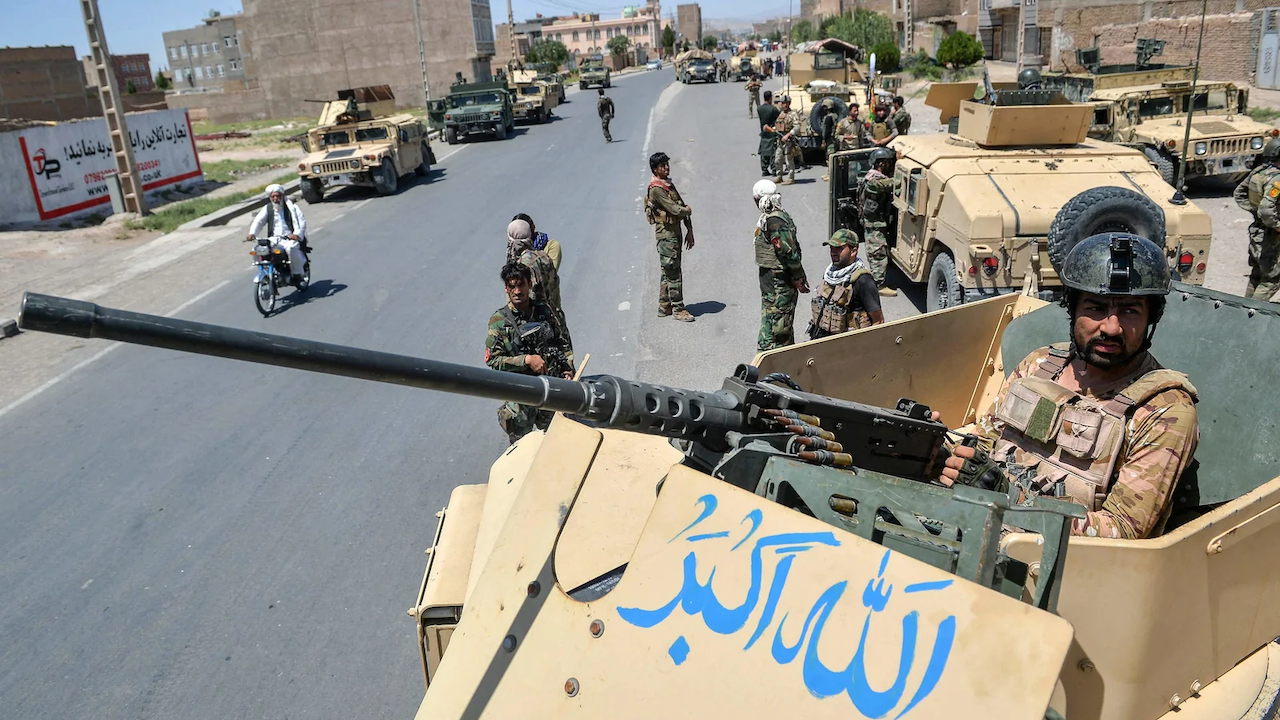
The U.S. government sent thousands of troops back into Afghanistan to evacuate U.S. personnel and some of their Afghan supporters just before the Taliban was about to overtake the capital, Kabul.
U.S. imperialism, its allies, China, and others supported a number of groups that formed in response to the Soviet Union’s invasion of Afghanistan in 1979. Many of the groups fighting against the invasion were religiously based groups, known broadly as the mujahideen. The Soviet Union was defeated and forced to withdraw in 1989. From that point on, Afghanistan was torn apart by a horrific civil war between opposing factions. The Taliban was formed in 1994, uniting a number of these groups. The fighting continued with U.S. and other major powers sometimes shifting their support from one group to another or, at times, standing by with no clear policy. In 1996, the Taliban seized power in Kabul, the capital, declaring the founding of the Islamic Emirate of Afghanistan.
By 2001, the Taliban had seized control over most of the country. During this time, the U.S. had begun to rebuild relations with forces opposed to the Taliban regime, hoping to regain some control over the region. Then, after the attacks of 9/11, which were attributed to Osama bin Laden’s Al Qaeda, the U.S. launched a major attack in Afghanistan, beginning 20 years of war that has killed more than 50,000 civilians and wounded hundreds of thousands more. It has caused untold misery, and solved nothing for the Afghan people. Since the Soviet invasion, more than a million Afghans have been killed and three million maimed or wounded.
The current Taliban victory will mean more wretched oppression, especially of Afghan women and children. But it was the long history of U.S. and other imperialist powers’ exploitation and oppression of Afghanistan and the Middle East that set the stage for the formation of groups like the Taliban and this latest crisis. The responsibility rests in the hands of the U.S. government under Carter, Reagan, Bush, Clinton, Bush, Obama, Trump, and now Biden. It has spent trillions of U.S. taxpayers’ dollars and created decades of misery for the Afghan people.