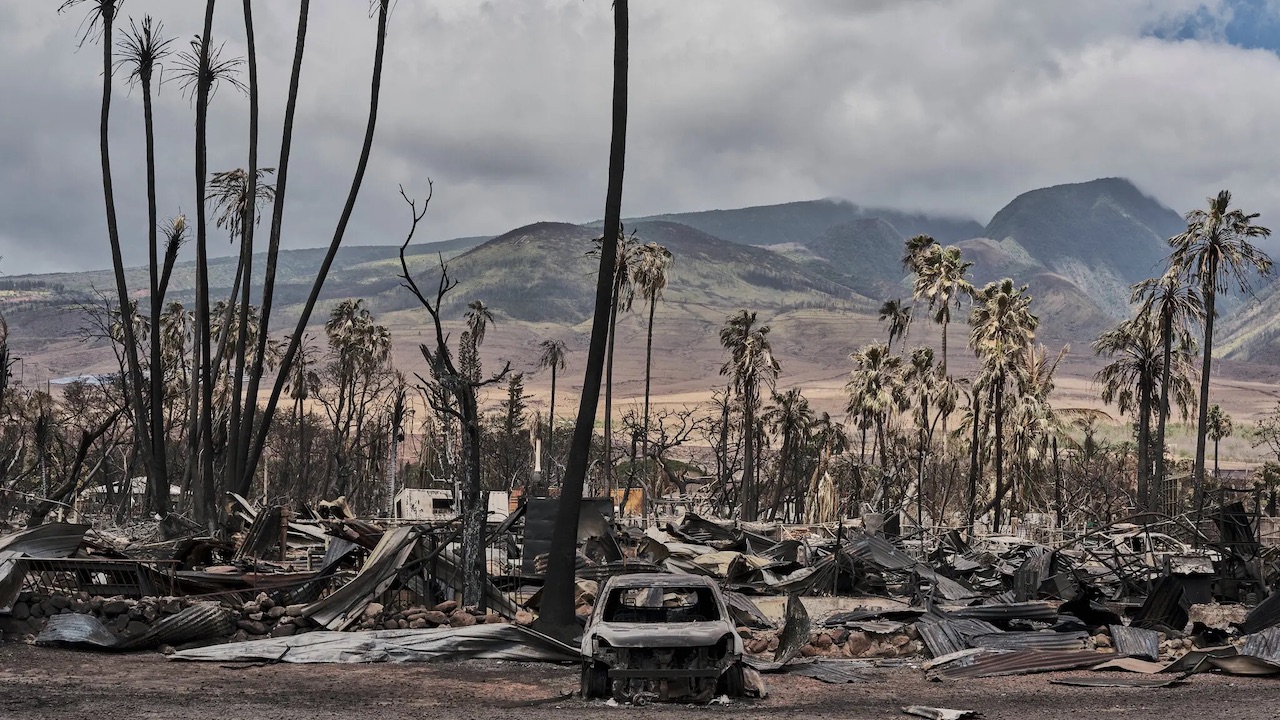
The death toll continues to rise from the fire that has ravaged the island of Maui in Hawaii. More than 90 deaths have been recorded so far, but the number is almost certain to rise. The fire is the worst so far in modern U.S. history, worse than the 2018 Camp fire in California which killed 85 people, and certainly the worst that Hawaii has ever seen.
What led to this horribly destructive fire? In the wake of the worst heat-wave in recorded history, it should come as no surprise that climate change is a major cause of the fire. Hawaii, like the rest of the United States, is facing unprecedented high temperatures. And driven by this extreme heat, Hurricane Dora, hundreds of miles away from Hawaii, was still able to create winds of 70 miles per hour on Maui. The strong winds worked with the dry heat to quickly spread the flames, increasing their destructive power.
If the forces unleashed by climate change weren’t bad enough, Hawaii has been set up for disaster by the history of capitalist agriculture. Hawaii was annexed in 1898 in a violent takeover from the indigenous Hawaiian people. Since then, big agricultural companies cleared much of the land and diverted many of the natural streams in order to grow products for export, like sugar cane and pineapples. Hawaii became a state in 1959. Billions upon billions of dollars were made off of the Hawaiian plantations throughout the 20th century. Since the 1990s, as these plantations became less profitable, companies moved on and the plantations were overrun by non-native grasses and other plants, highly susceptible to fire. The last sugar cane plantation closed down in 2016, and has been overrun with extremely flammable grass. The Hawaiian landscape became a tinderbox ready to explode.
The infrastructure of Hawaii was further degraded as the plantations were abandoned. For decades, the state of Hawaii has cut back on funding for land management that might have controlled the spread of flammable grass species. During the fire, the Hawaiian Electric Company refused to de-energize its power lines when hurricane winds and high temperatures became an obvious risk, catering to the short-term interests of the expensive resorts and the wealthy neighborhoods. Recent droughts degraded the water supply, while massive resorts and expensive homes drained what little water was left. The result was that firefighters had no water available from fire-hydrants in neighborhoods such as Lahaina. In other words, the infrastructure of Maui was in no way prepared for the fires that erupted, and the destruction and death caused by this disaster are a direct consequence.
Residents of Maui are not only devastated by the loss of life, and the destruction of their homes; they fear that the fire will speed up a process that has already been underway for some time — the continued displacement of native Hawaiians. Hawaii faces a housing shortage. The high prices of homes, rising rents, and low wages have led to a massive migration of native Hawaiians to the mainland. Wealthy developers building resorts, condos and other high-priced real estate are eager to use the consequences of the fire as a means to clear people out even faster. How will Maui be rebuilt? Let’s not forget how rich developers and real estate owners used Hurricane Katrina in 2005 to rebuild Louisiana the way they wanted, while a quarter of a million poor and working class people, mostly African Americans and other minorities, never returned.
The fire on Maui is an example of what is becoming more and more common — climate change causes disasters, while the capitalist system built on profit does nothing but make the problems worse. Then, the wealthy and big corporations take advantage of the aftermath to enrich themselves. This system cares nothing for peoples’ lives, for historic communities and cultures, or for the planet. The profit-driven destruction of the ecosystem and the consequences for humanity are on naked display in this horrific disaster. The Maui fire is another horrific reminder of what is to come if we don’t get rid of this system once and for all.