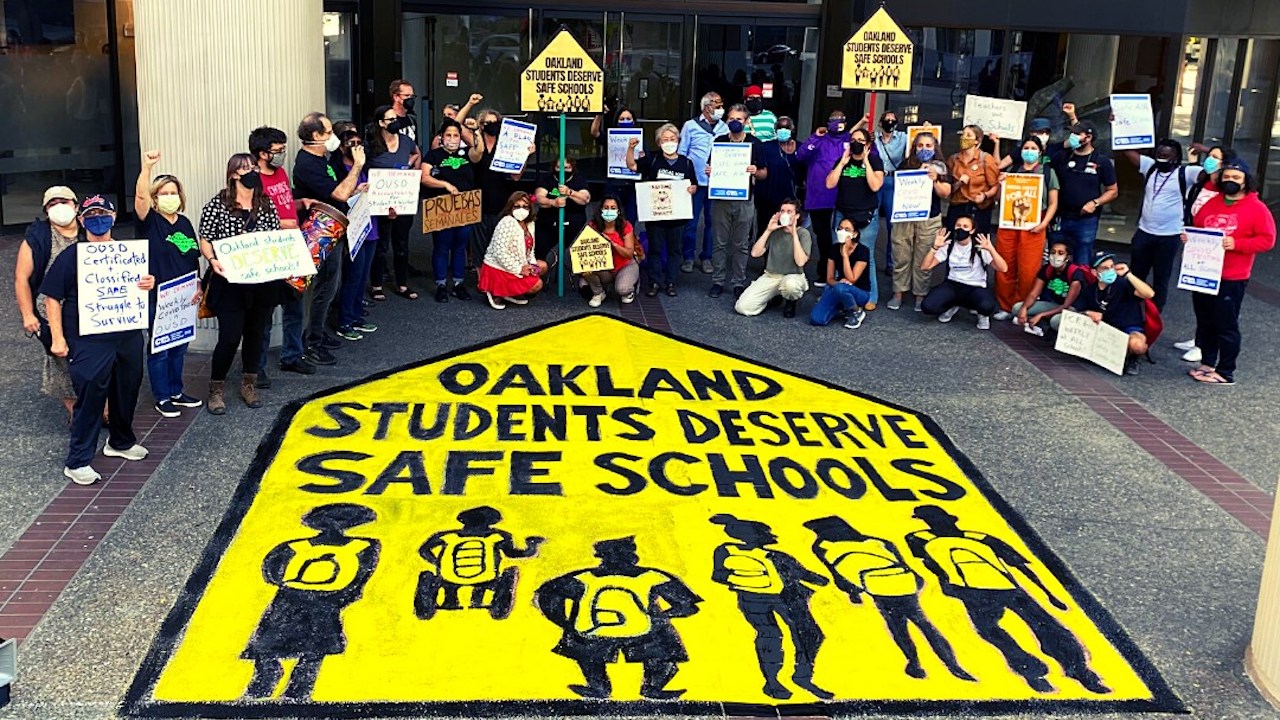
It’s been one month since the start of the school year in Oakland, and teachers’ and parents’ fears over COVID safety have not disappeared – but neither has their will to keep their children or themselves safe. We spoke with one Oakland Unified School District (OUSD) teacher for an inside glimpse into the current conditions faced by students, as well as the teachers and staff that keep the schools running, and what they’re doing to fight for safety.
This teacher says that unsafe eating conditions, lack of proper air ventilation, and inadequate testing are problems at many OUSD schools today. For one, a district-wide “breakfast for all” program was recently put into place. While it was a positive step towards responding to the issue of food insecurity, COVID safety measures were not considered in the roll out. Even with district-wide mask mandates in effect while indoors, this new program meant children were expected to eat breakfast, unmasked, inside the classroom. And as we know, masks are only effective at reducing spread if they’re actually being worn. Being inconsistent with masking rules is also “confusing, especially for young children,” as this elementary school teacher points out.
And while at least classrooms have air filters, many cafeterias have no means for air filtration – they’re simply too big for portable filters to be effective, and they haven’t yet been equipped with industrial-strength filters. So while students may be masked up in classrooms, all bets are off when it’s time to unmask and eat lunch. Some teachers have tried to address this by organizing to get rolling tables that can be brought outdoors, allowing children to eat more safely. The teacher we spoke with says her site currently offers outdoor dining, but only because “teachers and staff wrote a letter to our principle asking for these specific demands. And then we had parents come in, to advocate for more tables, to allow them to be more spread out.” But “this is only happening where people are advocating for it,” it’s not district policy.
Similarly, while some schools have testing, “it’s only happened because of site based individual advocacy.” And while this is a great step for those individual schools, it’s inequitable. Testing shouldn’t be determined site-by-site, it should be universal for all students and staff. “If one or two sites can do this,” this teacher believes, “we can do this for the district.”
And what often ends up happening when testing is not mandatory in the district, is “the second option of keeping children home for ten days.” So if families don’t have access to testing and a child shows any COVID symptoms, they must stay home for ten days. “Obviously kids are going to get sick, especially at this time of the year. So what happens is kids are getting sick with colds, and are spending ten days out. And then they’re going to get the flu, and are out for ten more days. If kids were getting tested, they could theoretically be in school more. I had ten students out on Friday, out of a classroom of 30. I don’t know if they had COVID or not.”
Inadequate testing also means there is little info about outbreaks when one does happen. If testing were readily available and mandated at schools, not only could children with a one-day sniffle return to school sooner, those with COVID could be spotted earlier, potentially before transmitting the virus to more students and staff. COVID spread could also be traced more easily (or at all). Instead, what happens now is “the secretary is trying to phone call families to trace. Other teachers are also calling families to attempt to trace.” Teachers and staff are not trained to trace outbreaks, but many have come to the conclusion that if the district is not going to step up, they will have to if they want to keep themselves and their students safe.
This realization that testing, outdoor tables, and other COVID safety measures are not going to simply be provided to schools, has led to the formation of “community safety meetings.” “People are scared, really really scared,” so these weekly meetings are a place for teachers, classified staff, students, and parents to get together and discuss their concerns. They’re also a place “to organize around these safety concerns, bringing organizing to the ground.” And for this teacher, “they’ve made a difference. For example, at my site we were given tents [for outdoor dining] instead of having to go out and buy them ourselves. And we got one more testing site.”
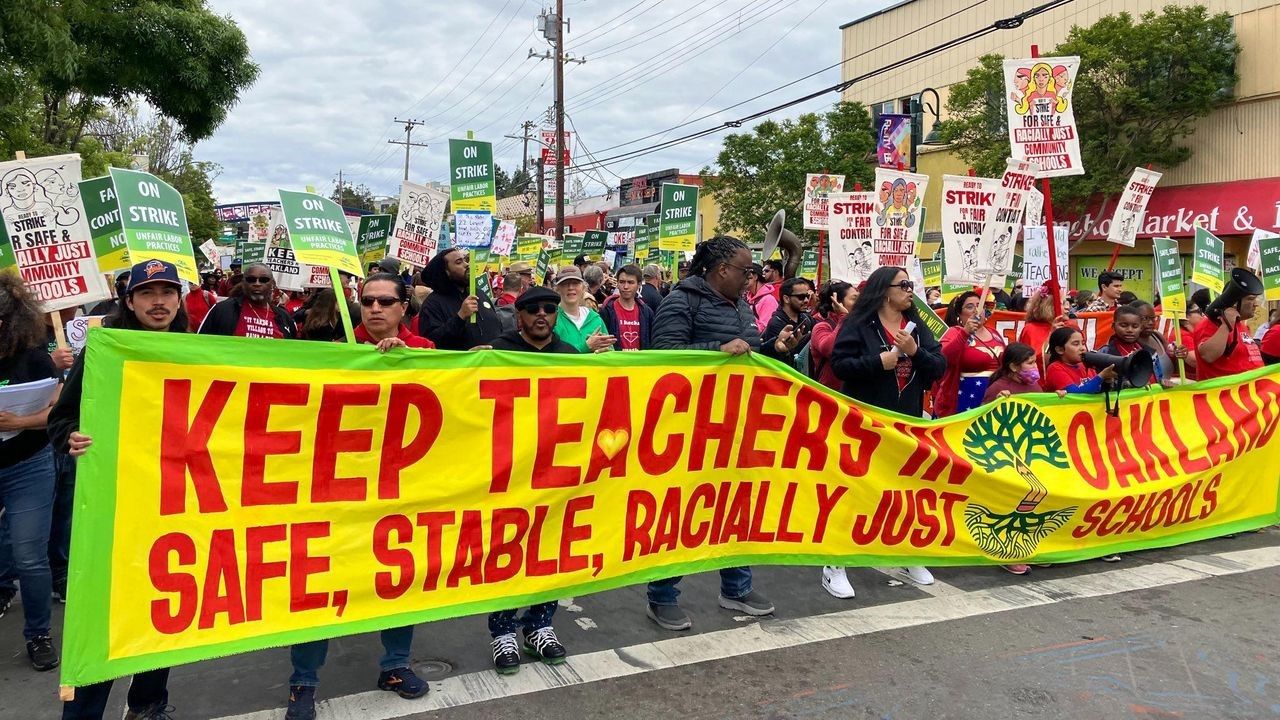
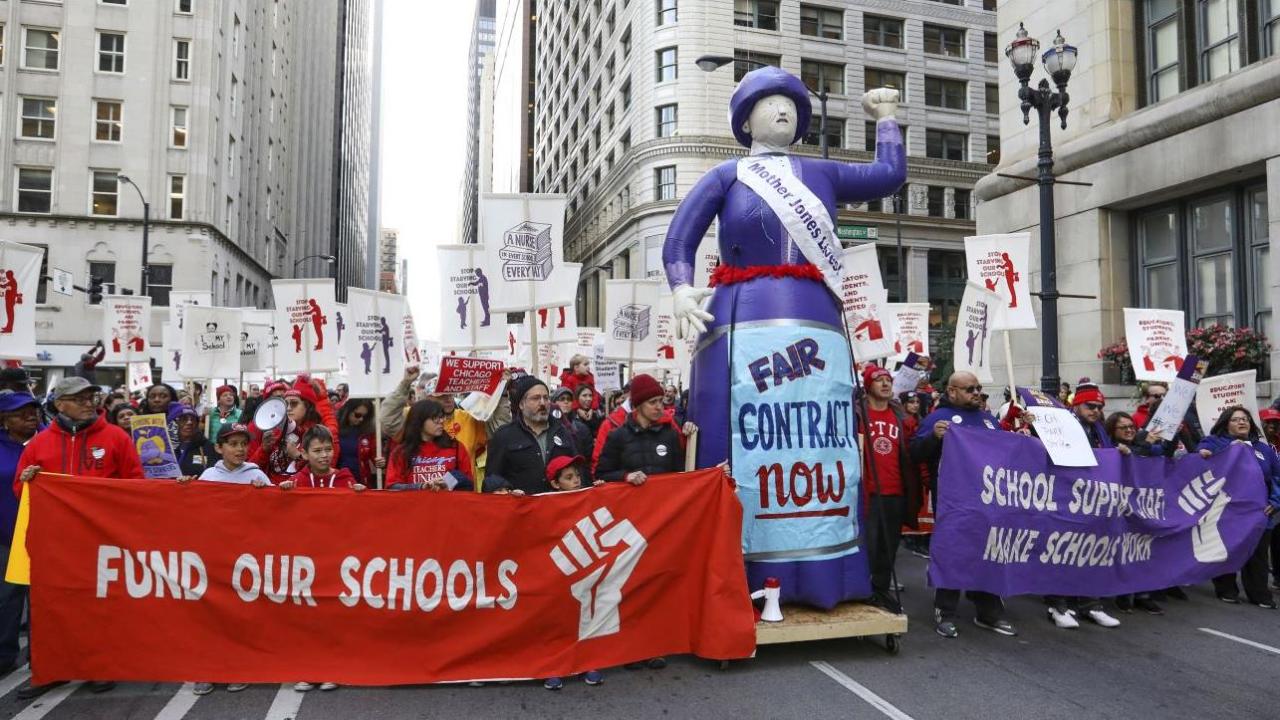
And with a new round of union bargaining about to begin with OUSD for COVID safety measures, “what we’re trying to do now is link safety committee work with bargaining work. We want to show the district, at the table, how powerful we are on the streets.” This means planning actions and events that can bring together the entire community to fight for safer conditions in the schools.
Among the list of demands “is mandatory testing at each school site for every student and staff,” along with “more resources at our facilities – more tents and rolling tables so schools can have safe mealtimes. And we need accountability on the $300 million received from the state. That money should be spent to help our school sites directly.”
While hopeful for these changes, this teacher makes it clear that “if we want to be powerful at the bargaining table, we need to simultaneously be organizing on the ground.” It has only been through the effort of teachers, staff, and parents that any of these safety measures have been granted at individual sites. So if the district is going to provide every school the safety measures being demanded, it’s going to be because they were fought for.