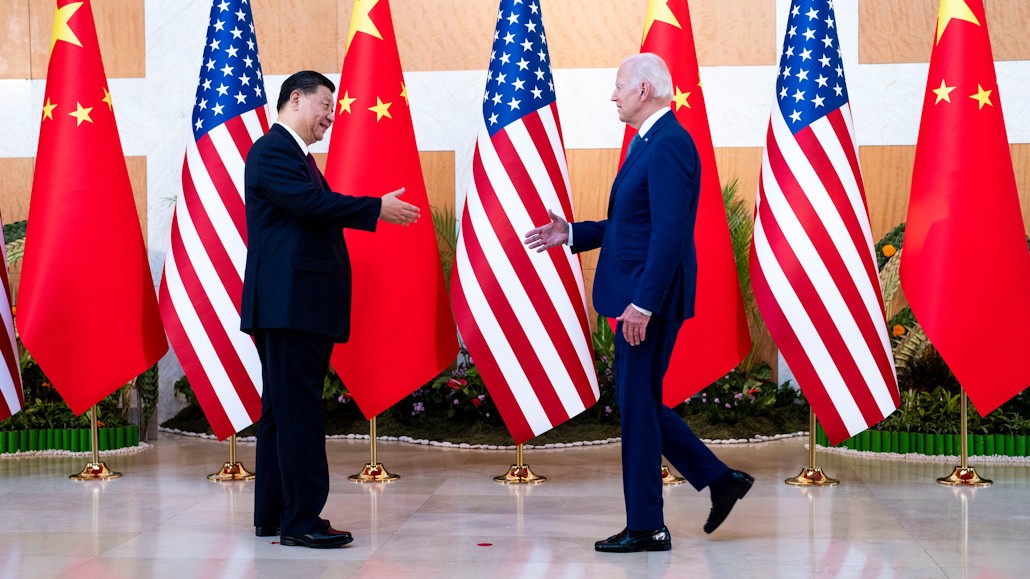
At the start of the recent Asia Pacific Economic Conference, Biden had a day-long meeting with Chinese President Xi Jinping. The prospect of more wars and climate catastrophes top the list of threats to human life and civilization. In spite of all of the fanfare, Biden and Xi accomplished nothing that will benefit the world’s people. Instead, they collaborated to spread the illusion that their governments recognize these threats and were doing something about them. In fact, they are doing nothing but making the problems worse.
The U.S. and China are in an arms race, preparing to fight each other in the South China Sea. The U.S., for nearly a hundred years, has maintained massive military forces in the Western Pacific. It has bases in Japan, South Korea, Australia, and the Philippines. Fleets of U.S. warships and aircraft patrol the South China Sea and the 70-mile-wide strait between Taiwan and mainland China.
Taiwan used to be a part of China, but now it is independent and has a government allied with the United States. It manufactures much of the world’s semiconductors on which the U.S. and other rich western countries depend. The Chinese showcase their growing naval and air forces to pressure the U.S. to withdraw its warships from the shores of China. The Chinese government sees backing the U.S. military out of the South China Sea as a step toward getting control of Taiwan and replacing the U.S. as the most influential power in Asia. Since the end of the Second World War, U.S. governments have regarded projecting military power toward Asia as the key to protecting U.S. companies’ huge investments in Japan and South Korea and retaining its status as the world’s top dog. As part of this, the U.S. has stepped up efforts to push Taiwan to upgrade its army and purchase more modern weapons from U.S. arms manufacturers. Biden has made it clear that the U.S. will use military force to keep China from taking over Taiwan. Neither country came to APEC prepared to back away from a future confrontation. But for the sake of appearances, both countries agreed to re-establish a hot line connecting the Pentagon with China’s military headquarters in Beijing.
Economic Rivalry
As part of an effort to curb China’s power, the U.S. tries to stop tech companies anywhere in the world from selling China their most advanced chips, many of which have military uses. Top tech corporations own factories in or depend on China to produce a lot of products cheaply because of the low wages Chinese workers are forced to accept. Some U.S. companies, like Tesla and Apple, manufacture some of their products in China and have made a lot of money from sales in China itself. Economic rivalry is intensifying because Chinese companies can manufacture products that compete with the best products the U.S. companies offer. In addition to restricting the export of the newest and most sophisticated tech to China, Biden wants U.S. corporations to gradually diminish their dependence on manufacturing in China.
For its part, China invited U.S. corporations to increase trade and investment in China whose economy is slowing, which threatens the stability of President Xi’s rule. U.S.-based banks and corporations have investments in China worth about $2.1 trillion and they are looking for assurances that the Chinese government will continue to let them make good profits. At the same time, they are under pressure from the U.S. government not to invest in ways that enhance Chinese overall economic and military power. Larry Fink, the head of Black Rock, the world’s largest bank, with $9.5 trillion in assets, has substantial influence over global investment. So it was not surprising that CEOs like Tim Cook of Apple and others had meetings with Xi and other Chinese government officials.
Climate Change
The U.S. and China produce 45% of the carbon dioxide pumped into the atmosphere annually. Both countries have broken countless commitments to lead the world to reduce the greenhouse gasses driving climate change. However, the U.S. continues to expand oil production and the Chinese continue to build coal-fired power plants.
Xi and Biden promised to work together against climate change, but what does this mean? The growth of hurricanes, wildfires and the melting of glaciers and polar ice packs testify to how well the governments of China and the U.S. work together to stop climate change. The economic and geopolitical rivalry generated by the rise of China and the relative decline of the U.S. will inevitably intensify. International rivalries of this sort are built into capitalism and imperialism. World wars grow out of such rivalries. If human civilization is not to be thrown back centuries or more, we will have to go forward to socialism, breaking the death grip of capitalism over the future of our lives and the generations to come.