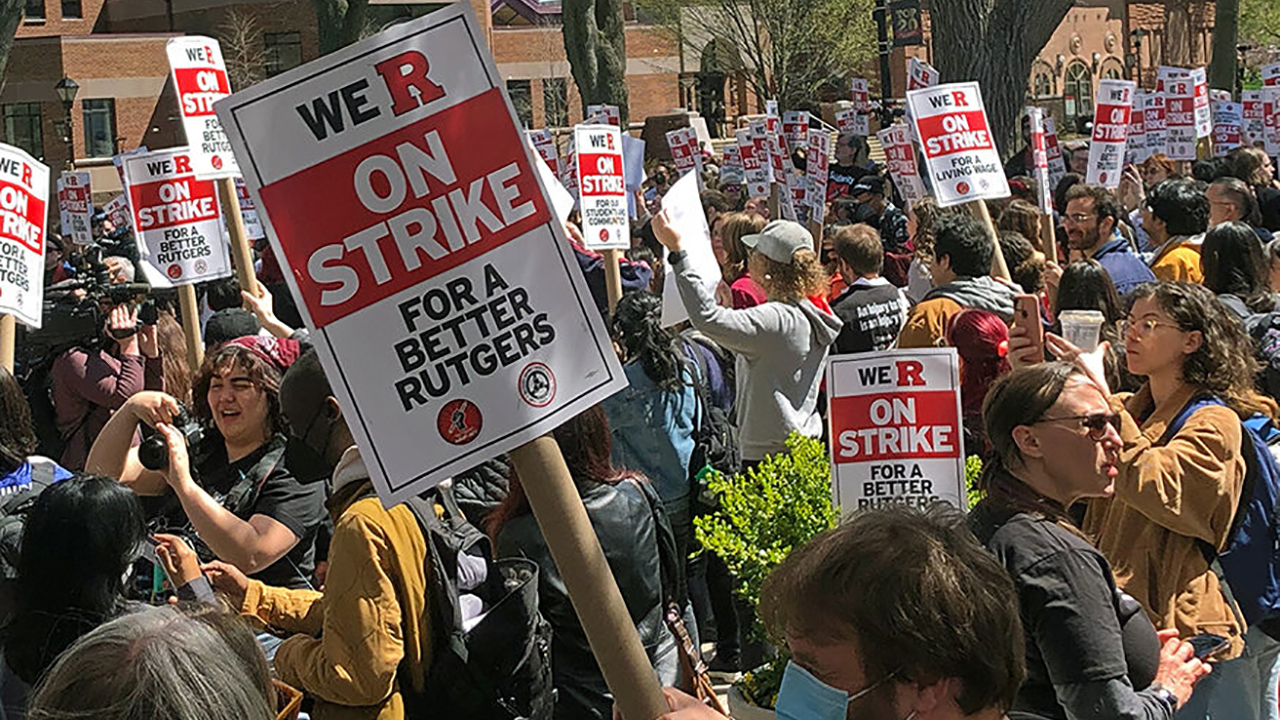
On Monday morning, nearly 9,000 tenured professors, part-time lecturers and graduate student workers went on strike at the three campuses of Rutgers University, the state university of New Jersey, and one of the largest state universities in the nation. The workers who make the university run are sick of Rutgers spending money on new buildings, mediocre sports programs and bloated administration, while they live hand to mouth.
The three bargaining units (AAUP-AFT, PTLFC, and AAUP BHSNJ) have been negotiating with the university for nine months and are fighting for a number of key demands. They want a four-year contract, with annual percentage raises of 5, 4.75, 4.5, then 4.25 for each respective year, with a cost of living increase to kick in immediately if inflation goes over 5%. They want a 37.6% pay increase over four years for graduate workers, who have traditionally struggled to survive either at or below a living wage. They want equal pay for equal work between not-tenured contract faculty, adjuncts, and part-time lecturers. They want longer appointments for contract employees, and guaranteed funding for five years for graduate and teaching assistants. They want more control over the conditions and systems that affect their teaching, and they want enforceable rights to academic freedom. And finally, in what would be a major step forward, they want the university to recognize all three bargaining units as one union moving forward. This spirit of collective unity was highlighted in a letter to the President of the University, Jonathan Holloway, written and signed by some of the most well known and widely published tenured professors.
At pickets on Monday and Tuesday, the energy on the picket lines for all three campuses was high, with lots of marching and chanting. With hundreds picketing on each campus, visibility was high for the strikers and their messaging. While the university said classes would continue as scheduled, it is clear that most classes have actually not taken place.
The outcome of this strike remains to be seen. Although the university administration threatened to go to court for an injunction and have been in contact with the Governor’s office, there has been no move to take legal action against the strikers.
But as always, legal wrangling won’t be the deciding factor. If the Rutgers workers and their unions hold strong and win support from the wider working class, then they can win the strike no matter what the courts and politicians do.