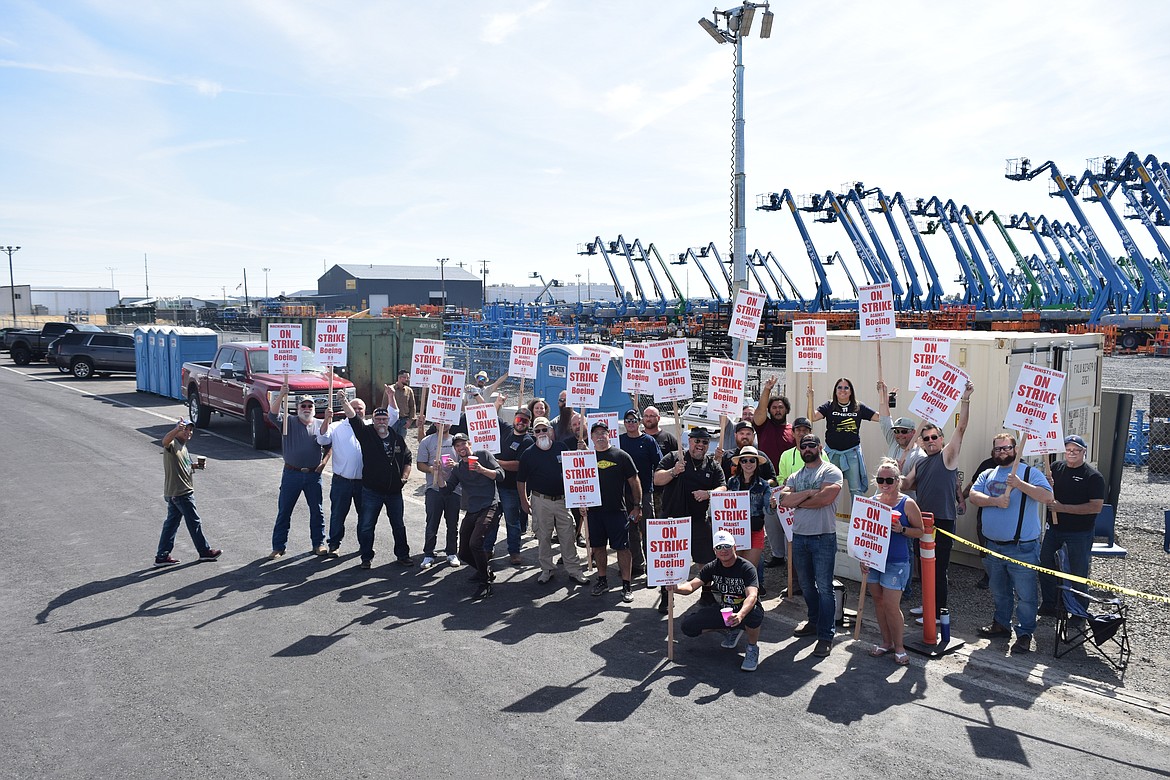
As the strike of Boeing workers in Seattle, Washington enters its fourth week, negotiations between the International Association of Machinists (IAM) and Boeing management have come to a halt. The strike began Sept 12, after the 33,000 union members rejected a tentative contract recommended by the IAM officials. The last Boeing strike, in 2008, lasted 58 days.
Two weeks into the strike, Boeing attempted to bypass the IAM negotiating committee and publicly announced a new offer with an increased wage package, including the partial restoration of the annual bonus. Hoping to stampede the members, Boeing insisted the offer had to be accepted by Friday, or it would be withdrawn. Boeing’s tactic backfired, producing an indignant backlash from members who reasoned that while they – the union members – had the right to reject the advice of the union officials, it was entirely a different matter for the company to attempt to go over the heads of the elected bargaining team.
Acknowledging the members’ indignation, the union officials announced there would be no vote on Boeing’s second and slightly improved wage offer. Boeing has now withdrawn that proposal and cut off the workers’ health benefits. At this moment no further negotiations are scheduled. Boeing management blames the union for the breakdown of negotiations, claiming the IAM is making unreasonable demands given the company’s poor financial position.
The workers quite rightly blame management for the company’s financial troubles. Workers say the rash of crashes and near crashes of Boeing’s best-selling aircraft, the 737s, are the result of management’s decisions to speed up production by cutting back on labor-intensive production standards necessary to assure the planes will be safe to fly. Management’s reckless pursuit of profits at the expense of safety standards for the 737s has compromised the company’s reputation with the airlines and the flying public, increasing Boeing’s persistent financial troubles.
Boeing workers don’t believe they should pay the price for management’s choices. Starting pay at Boeing is not much more than the minimum wage in Seattle. They point out that Boeing’s bosses have gotten huge salary increases and pumped company revenues into stock buybacks and dividends for its investors even though Boeing hasn’t made a profit in six years. Workers wages have lost a lot of buying power thanks to inflation over the four-year life of the expired contract.
In the proposed 4-year contract, the union is demanding an overall increases of more than 40% weighted in favor of the lowest-paid crafts, a restoration of the annual bonus, reductions in compulsory overtime, a restoration of a pension with guaranteed benefits, and a strengthened role for workers in enforcing production standards, including hiring more union inspectors to certify the quality of parts and assembly. Workers also want an end to management pressure to take shortcuts in production, which compromise the safety of the Boeing’s planes, and a legally binding guarantee that Boeing will not move production of future planes to non-union facilities outside the Seattle region.
The union pays strike benefits of just $250 per week. It is urging workers to sign up for government health care programs which offer fewer benefits than what the workers are used to, and can be costly for families with serious medical needs, like cancer treatment. Nevertheless, workers interviewed on the picket lines assure TV and newspaper reporters that they are united and prepared for a long strike.
The strike has made an immediate impact on Boeing’s already weakened financial situation. It’s estimated that Boeing loses at least $50 million for each day on strike. It may have to go to Wall Street for funds to tide it over, and it can only get those funds at a much higher interest rate than what financially stronger companies pay. Boeing’s problems making profits will persist, given how its sales have fallen behind Airbus, its primary competitor, and its spacecraft business is losing the competition with Elon Musk’s technologically advanced and non-union SpaceX. Boeing’s defense business is reportedly also not very profitable.
Given all these pressures, Boeing has a big incentive to get the strike settled quickly, but at the same time a settlement which gives the workers much of what they want will not improve the company’s profitability in the short term. The skilled nature of the work means that Boeing can’t replace the workforce with scabs. A long strike could hurt the company more than the workers, which is not usually the case, and competitors will get lasting advantages if Boeing suffers a long strike.
The weak link in this situation might well be the union’s leaders. In the past IAM officials have pushed through ratification of poor contracts using unscrupulous maneuvers, like staging votes when it was difficult for all members to vote and withholding critical information. The IAM is rich and could afford to pay much more than $250 per week in strike pay. It could do more to help workers cover their healthcare costs. Is the lack of ample financial support for the strikers a warning that the union is far less committed to winning the strike than its members on the picket line? Workers have already rejected one substandard contract offer recommended by the union officials. This makes it clear that the rank and file are more alert and ready to fight than in the past. Militant IAM members need to organize to maintain the pressure of the engaged rank and file on the union’s top leaders.